

The best-looking gold EA may still be the wrong one for your account. The best gold trading ea bot isn’t identified by a polished equity curve or a headline return. It should fit your preferred strategy, account for gold’s volatility, and work with your trading platform and setup.
If promotional results are difficult to assess, use a consistent checklist. Backtests, screenshots, and win rates alone don’t show how an EA may behave during drawdown or whether its requirements match your broker and account. Automation also can’t remove trading risk.
This guide gives you a practical framework for comparing gold EAs by strategy fit, risk controls, evidence quality, and execution requirements. You’ll learn what to inspect before deployment and how to assess performance claims. We’ll also consider RobotForexPro’s RFP GoldenStar EA and RFP Gold V5.7 EA alongside those criteria, so product names don’t substitute for careful comparison.
Key Takeaways
- Match a gold EA’s strategy and execution requirements to your trading plan, platform, and account conditions.
- Assess gold-specific volatility, spreads, and slippage because they can affect how an automated strategy performs in live trading.
- Compare returns alongside maximum drawdown, trade history, record duration, and account conditions. No backtest or verified record guarantees future results.
- Use a defined selection process: set risk limits, examine evidence, confirm platform fit, test on demo, then monitor live behavior.
- Evaluate gold EAs, including RFP GoldenStar EA and RFP Gold V5.7 EA, using consistent criteria. Don’t assume strategy, platform, or performance details from a product name.
What makes a gold trading EA bot a fit for your trading plan?
A gold trading EA is software that applies programmed rules to analyze market data and, depending on its design, place or manage trades in gold instruments such as XAUUSD. It automates defined tasks, not market risk. Losses remain possible. An EA is software, not a managed account or brokerage service.
Fit is more than a performance figure. A practical evaluation separates four questions: Does the strategy suit your approach? Do its potential losses fit your risk limits? Does it run on your platform and account setup? Is its performance evidence detailed enough to assess? The best gold trading ea bot for one trader may not suit another.
What does a gold trading EA bot actually automate?
An EA may scan prices for rule-based signals, then open, adjust, or close orders according to its programming. The rules and degree of automation vary by system. An automated trading system follows programmed logic. It doesn’t independently decide whether the trader’s objectives or account settings make a trade appropriate.
The trader remains responsible for configuring the account, selecting risk settings, checking platform compatibility, and monitoring activity. An EA doesn’t remove the need to understand what it can do or how it may behave when market conditions change.
Why does gold require a specific evaluation lens?
XAUUSD can make sharp moves, and trading conditions can shift across market sessions. Spreads may widen, execution may be delayed, and slippage can cause an order to fill at a different price than expected. These factors can affect entries, exits, and realized results, especially for systems that trade frequently or rely on small price movements.
Don’t assume a bot designed for a currency pair will behave the same way on gold. Check how its stated approach aligns with XAUUSD conditions, then consider whether your broker’s execution environment and your ability to monitor the account fit that approach. No single strategy is right for every gold market or trader.
Use these four dimensions to frame your comparison:
- Strategy: Understand the general trading approach and when it is designed to operate.
- Risk profile: Examine how the system handles losing trades and whether its exposure fits your limits.
- Platform fit: Verify that the EA supports your trading platform and account setup.
- Evidence: Evaluate the quality and context of performance records, not just headline results.
This framework turns “Which bot looks best?” into a more useful decision: which system’s behavior, operating requirements, and evidence align with your plan?
How gold EA strategies and execution behave in changing markets
An EA follows its programmed rules, but XAUUSD conditions can change how those rules play out. A volatility spike may push price through an entry or stop level quickly. Wider spreads can increase the cost of opening and closing positions, while slippage can move an order’s fill away from its requested price. These effects can alter realized results even when the software behaves as programmed.
How do market conditions affect XAUUSD automation?
Volatility influences more than price direction. It can affect how often a system enters, how quickly it exits, and whether a stop distance or position size remains appropriate for the account. Around major news or during shifts in liquidity, prices may move rapidly and execution conditions may change. Historical results may not reflect those conditions. Neither a backtest nor a live record can establish future performance or remove the risk of loss.
Assess the whole execution environment, not just the strategy description. Consider whether the system’s operating assumptions match your broker’s spreads, order execution, and the sessions you intend to trade. A strategy that appears viable under one set of conditions may behave differently when spreads widen or fills are delayed.
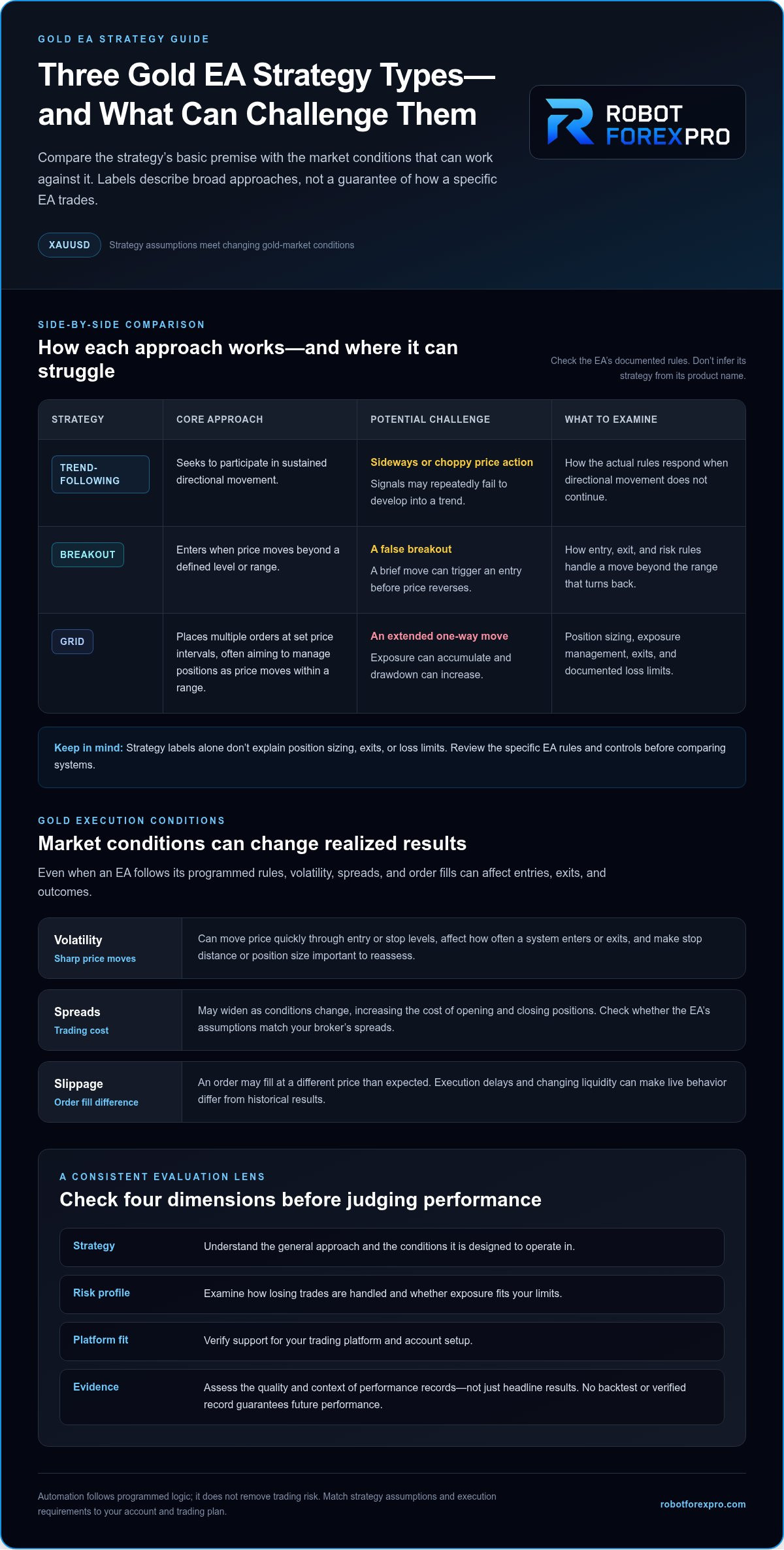
What strategy labels should traders understand?
These labels describe broad approaches, not a guarantee of how a specific product trades. Each has conditions that can challenge its underlying premise:
Trend-following: Seeks to participate in sustained directional movement. Choppy, sideways price action can produce repeated signals that fail to develop into a trend.
Breakout: Enters when price moves beyond a defined level or range. A brief move that reverses, sometimes called a false breakout, can trigger an entry before price turns back.
Grid: Places multiple orders at set price intervals, often aiming to manage positions as price moves within a range. A strong, extended move in one direction can accumulate exposure and increase drawdown.
Use this compact comparison as a starting point, then examine the actual rules and risk controls documented for the EA you’re evaluating. Don’t infer strategy type from a product name or assume a label explains position sizing, exits, or loss limits.
Comparison snapshot: Trend-following relies on sustained direction, with reversals and sideways movement as key concerns. Breakout systems rely on movement beyond a range, with false breaks as a concern. Grid systems use spaced orders, with extended directional moves as a concern.
The best gold trading ea bot is not simply the one with the most attractive headline result. Compare strategy assumptions with execution conditions and your risk tolerance. To review RobotForexPro’s gold EA options, apply the same checks to each product rather than assuming they share a strategy or requirements. Explore RobotForexPro gold EA options.
How to verify a gold EA bot's results, drawdown, and risk
A strong-looking return is only one part of the record. Backtests and independently tracked live results can help you assess an EA, but neither guarantees future returns or removes the possibility of loss. Interpret performance alongside drawdown, trade history, record duration, and the account conditions behind the figures.
Which performance metrics matter beyond headline returns?
Drawdown measures the decline from an account or equity peak to a later low. It provides context for the losses an account experienced during a particular period, but it doesn’t predict the size or timing of future declines. Net return also needs context: the period measured, account type, position sizing, and execution conditions can all affect how results compare.
Read win rate with average win, average loss, and trade frequency. A high proportion of winning trades may still coincide with poor outcomes if losing trades are much larger, or if the system opens trades frequently under conditions different from those in the record.
How should traders assess backtests and live records?
A backtest applies a strategy to historical market data under modeled assumptions. A live record reflects trades placed in a real account, though the account’s settings and execution still shape the result. Independent tracking services such as Myfxbook can make a live record easier to inspect, but a verified record is evidence to evaluate, not proof of what will happen next.
Review the record’s duration and full trade history, then compare its account type, sizing, and trading conditions with your own setup. Avoid comparing a short test on one account with a longer record on another as if they were equivalent.
| Metric | What it indicates | What it cannot prove |
|---|---|---|
| Net return | Outcome over the stated period and account | Future gains or comparable results on another account |
| Maximum drawdown | Largest recorded peak-to-trough decline | The maximum loss the system could experience |
| Win rate and trade history | How often trades won and how outcomes were distributed | Profitability by itself, without loss size and frequency |
| Record duration and account conditions | Context for interpreting the results | Performance across every market environment |
Use the same checklist for every candidate. No single metric identifies the best gold trading ea bot. Look for evidence you can interpret in context and recorded risk that aligns with your own limits.
How to choose a gold trading EA bot for your account
Use a repeatable selection process before installing an EA. This keeps product claims separate from your account requirements and helps you identify practical mismatches before live trading.
- Define your risk limits. Record your trading objectives, the loss or drawdown you can tolerate, your intended trading schedule, and how often you can monitor activity. These limits help you judge whether an EA’s documented behavior is relevant to your plan.
- Review the evidence. Compare performance records over similar periods and weigh net results against drawdown, trade history, and account conditions. Treat a headline return as one data point, not a selection rule.
- Check platform and account fit. Read the EA’s documented platform support, account requirements, and operating parameters. Confirm that these match your intended setup before proceeding.
- Test the setup on demo. Check installation, platform operation, order behavior, and whether the EA’s activity aligns with its documentation and your predefined limits.
- Monitor any live use. If you decide to move beyond demo, continue reviewing exposure and trading behavior against your limits. A change in market or execution conditions can alter outcomes.
What should you check before selecting an EA?
Keep a simple comparison record for each candidate. Note your risk criteria, the evidence period and account context, platform requirements, and parameters that affect how the EA operates. Apply the same criteria to every option. This makes it easier to spot missing information or mismatches without treating a product description as proof of suitability.
How can you test an EA before live use?
Start with the documented setup on a demo account. Observe whether the EA initializes correctly, places and manages orders as described, and operates consistently on the intended platform. Review trades and exposure, not just the account balance. Demo testing can reveal setup issues and help you understand behavior, but it doesn’t establish future profitability. Demo fills and execution conditions may differ from live trading, so treat the test as an operational check rather than a performance guarantee.
Make the decision independently. Choose an EA whose documented requirements and observed behavior fit your plan, not simply the one with the strongest promotional result. Apply the same checks to RobotForexPro’s software. Review RobotForexPro EA software against your platform, account, and risk criteria.
RobotForexPro gold EAs: compare the options and next steps
RobotForexPro sells two gold EAs: RFP GoldenStar EA and RFP Gold V5.7 EA. Compare each with the same criteria, including strategy, platform compatibility, parameters, risk controls, and performance evidence. A product name alone doesn’t establish how an EA trades or whether it fits your account.
How should readers compare RFP GoldenStar EA and RFP Gold V5.7 EA?
Start with each product’s stated specifications and assess them against your own setup. Don’t assume the products share operating requirements or that one is better for every trader.
| Product | Verified distinction |
|---|---|
| RFP GoldenStar EA | RobotForexPro gold EA |
| RFP Gold V5.7 EA | RobotForexPro gold EA |
For each product, compare the stated platform and account requirements, strategy description, configurable parameters, risk controls, and performance evidence. Check what any record measures and the conditions under which it was generated. Base your comparison on product specifications and evidence, not assumptions drawn from a product name.
This approach keeps product identity separate from product suitability. The best gold trading ea bot is not automatically the one with the more compelling name or stronger claim. It’s the one whose specifications and evidence fit your platform, account conditions, and risk plan.
What are the next steps before using a gold EA?
Review the specifications for the EA you’re considering. Match its stated platform and account requirements to your intended setup. Then test the installation and order behavior in a demo environment, and check that the activity aligns with the documented parameters. Demo testing can help reveal setup issues, but it can’t prove future profitability or guarantee that live execution will be identical.
Choose independently and keep risk controls in place. Automated trading carries a risk of loss, and neither an EA nor historical results can assure future outcomes. Compare RobotForexPro’s gold trading EAs using your evaluation criteria.
Make Your Gold EA Decision With Clear Criteria
The best gold trading ea bot isn’t defined by a headline return. Choose with a consistent framework: match the EA’s stated strategy and operating requirements to your account, assess net results alongside drawdown and trade history, and test setup and behavior in a demo environment before considering live use.
RobotForexPro’s gold offerings include RFP GoldenStar EA and RFP Gold V5.7 EA. Compare their specifications and performance evidence against your platform, account conditions, and risk limits. Treat all performance records as historical information, not a promise of future results. Automated trading involves risk, and losses are possible.
Explore RobotForexPro’s gold trading EAs and compare the product details with the criteria in this guide. A measured, evidence-led decision helps you assess your options with greater clarity.
Frequently Asked Questions
What is the best gold trading EA bot?
There’s no single best gold trading EA bot for every trader. Compare each option’s stated strategy, risk controls, performance evidence, platform requirements, and fit with your account limits. RobotForexPro sells gold EAs including RFP GoldenStar EA and RFP Gold V5.7 EA. Treat the product names as starting points for comparison, then assess their specifications and evidence rather than choosing by headline claims alone.
Are gold trading EA bots profitable?
They can generate profits, but losses are also possible, and past results don’t establish future performance. Outcomes depend on the EA’s rules, market conditions, account settings, and trade execution. Assess net return alongside maximum drawdown, trade history, and the conditions behind the record. A high win rate or positive backtest alone isn’t enough to determine whether a system is profitable or suitable for your account.
Can an EA trade XAUUSD automatically?
Yes, an EA can place and manage XAUUSD trades automatically if it’s programmed for that instrument and supported by the trading platform. The degree of automation varies by system. Before use, review its stated operating rules, account requirements, and settings. Automation doesn’t remove market risk or your responsibility to configure the account, monitor trading activity, and decide whether the system remains within your risk limits.
How do I verify a gold trading bot's results?
Review independently tracked live-account evidence where available, then examine the full trade history, record duration, net return, maximum drawdown, and account conditions. Services such as Myfxbook or FXBlue can help make performance records inspectable, but a tracked record still needs context and doesn’t guarantee future results. Compare records over similar periods and conditions. Treat screenshots and backtests as limited evidence, not proof of live performance.
Is a backtested gold EA safe to run live?
No. A backtest shows how programmed rules performed against historical data under specific assumptions. It can help assess a strategy, but it can’t establish live execution quality or predict future results. Test installation and order behavior in a demo environment first, then review exposure against your risk limits. Demo testing also doesn’t guarantee live performance, and trading XAUUSD carries a risk of loss.
What is the difference between a gold EA and a gold trading bot?
The terms often overlap. A gold Expert Advisor, or EA, usually refers to trading software designed to operate within a compatible trading platform, while “gold trading bot” is a broader informal term for software that automates gold-market tasks. Labels alone don’t explain a system’s strategy or capabilities. Review the product specifications to understand what it automates, which platform it supports, and what settings remain under your control.
Can I use a gold EA on MetaTrader 4 or MetaTrader 5?
That depends on the individual EA. MetaTrader 4 and MetaTrader 5 are separate platforms, so don’t assume a product supports both. Check its stated platform versions, account requirements, and setup instructions before installation. For RFP GoldenStar EA or RFP Gold V5.7 EA, use the product specifications to assess platform fit, then test operation in a demo account before considering live deployment.