

What if an EA that runs smoothly on major currency pairs behaves very differently on gold? The real question is: does forex ea work for gold? Sometimes, but compatibility alone isn’t enough. XAUUSD can move sharply, and differences in symbol settings, spreads, execution, and position sizing can expose weaknesses in an EA’s design.
It’s reasonable to question whether a currency-focused system can handle gold’s price behavior and your broker’s trading conditions. An EA needs to recognize the correct symbol and handle the instrument’s specifications, order parameters, and risk settings. A successful currency-pair backtest doesn’t establish that the system is suitable for XAUUSD.
This guide explains when a Forex Expert Advisor can trade gold and what to inspect before using one. You’ll learn how symbol settings, volatility, slippage, and strategy design affect compatibility, then see how to assess historical results and test an EA on a demo account. The goal is a measured decision based on evidence, not product claims or assumptions.
Key Takeaways
- An EA’s ability to trade XAUUSD depends on its design and the broker’s trading conditions, not simply on whether the software runs.
- Gold’s price changes, spreads, and slippage can affect execution and reveal weaknesses in generic EA logic.
- Compare supported instruments, symbol handling, platform compatibility, and documented operating conditions before testing.
- Answer “does forex ea work for gold” with a structured evaluation: match the documented setup, test in a controlled environment, then assess live conditions cautiously.
- Consider gold-focused EA options with clear expectations, while keeping deployment decisions and trading risk under your control.
Does a Forex EA Work for Gold? The Direct Answer
Yes, some Forex Expert Advisors can trade gold, but not every EA is compatible with XAUUSD. Compatibility depends on the software’s design, its supported platform and symbol, and whether its assumptions fit the broker’s account conditions. An Expert Advisor (EA) is software that follows programmed trading rules within a supported trading platform. It can identify a signal and submit an order automatically, but that capability alone doesn’t show that the strategy is suitable for gold.
Algorithmic trading uses computer programs to make or execute trading decisions according to defined rules. An EA’s rules might specify when to enter or exit a position and how to size an order. The details matter: a system built around typical currency-pair behavior may not account for XAUUSD’s price movement or trading specifications.
XAUUSD is a commonly used symbol for gold priced against the US dollar. Brokers may use different symbol names or suffixes, so an EA configured for one symbol may not automatically recognize another. Compatibility also doesn’t establish profitability, suitability for an account, or acceptable risk. Those require separate evaluation and testing.
What does it mean for an EA to support gold?
The EA must recognize the broker’s gold symbol and handle the instrument’s trading specifications correctly. That includes interpreting price changes and submitting orders with valid volume and order parameters. A successful order proves only that the software can communicate with the trading environment. It doesn’t prove that the EA’s entry, exit, or risk logic was designed for gold.
For example, an EA may accept XAUUSD but apply position-sizing or stop-distance assumptions intended for a currency pair. That can produce a different level of exposure or order behavior than expected. Check the EA’s documented symbols and settings, then test it on the supported platform using the account conditions you intend to run.
Why a general Forex EA may not be gold-ready
Trading conditions vary by instrument and broker. Spreads can differ, execution can involve slippage, and trading hours may not match an EA’s assumptions. Contract size, tick value, and minimum trade volume can also vary by broker. These specifications affect how an order translates into account exposure, even if the EA’s code runs without errors.
Don’t transfer currency-pair settings to XAUUSD by default. Compare the EA’s documented requirements with the broker’s symbol and account specifications, then evaluate the system in a controlled test before considering live use. Gold compatibility must be tested against the actual symbol and account conditions.
How Gold Trading Conditions Affect Forex EA Performance
Gold can make fast price changes, but its behavior isn’t identical in every session. An EA’s results depend on both what the market does and how the broker processes orders. A strategy may identify a signal yet receive a different execution price than expected, or encounter trading conditions its settings weren’t designed to handle.
A practical answer to “does forex ea work for gold” starts with matching the EA’s assumptions to XAUUSD. Reusing currency-pair defaults can misrepresent position exposure, costs, or order handling. News releases and liquidity changes can coincide with sharper moves or less predictable execution. Treat them as conditions to plan for, not dependable signals of which way gold will move.
How XAUUSD differs from a typical currency pair
XAUUSD represents gold priced against the US dollar. Gold is a precious metal, not a currency pair, and its price can respond to movements in the US dollar as well as changing market expectations. Those drivers can contribute to quick moves, but they don’t make every session behave the same way. An EA’s entry and exit rules need to account for the instrument it trades.
Why broker specifications matter to an EA
Brokers may identify gold with different symbol names or suffixes, and trading specifications can vary by account. Check the precise symbol, contract size, tick value, minimum trade size, and trading hours for the account you plan to use. Don’t assume an EA’s settings transfer unchanged.
Execution adds another layer. The spread is the difference between the quoted buy and sell prices; slippage occurs when an order fills at a different price than requested. Both can make live results diverge from tests that used different assumptions. For example, an EA designed around a narrow spread may behave differently when the actual spread widens. A strategy that depends on a specific order price can also be affected by delayed or variable execution.
Before deployment, compare the EA’s documented operating assumptions with the broker’s current XAUUSD conditions. Include periods of changing liquidity and scheduled high-impact news in your evaluation. A news spike doesn’t reliably predict direction, but it can quickly change price movement and execution conditions. Test under controlled conditions first, and keep account access, deployment, and trading risk under your control.
As you assess instrument fit, review gold-focused EA options alongside the specifications and test results relevant to your setup.
Forex EA vs Gold-Specific EA: What Should Traders Compare?
A gold label doesn’t establish that an EA is compatible, well-tested, or suitable for your risk limits. Compare the system’s documented behavior and requirements, not just its name or headline claims. Whether a Forex EA works for gold depends on whether its instrument support, settings, and evidence match the XAUUSD setup you plan to use.
| Comparison point | General-purpose Forex EA | Gold-focused EA |
|---|---|---|
| Supported instruments | May be designed around specified currency pairs; gold support should be documented separately. | Should state whether it supports XAUUSD or the broker’s corresponding gold symbol. |
| Symbol handling | May expect exact symbol names and settings that differ from a broker’s gold symbol. | Documentation should explain supported naming and any required symbol settings. |
| Strategy assumptions | May use entry, exit, or sizing rules built for currency-pair conditions. | Its stated strategy and operating conditions should address the instrument it targets. |
| Platform and conditions | Requirements may be specific to a platform, account, or execution environment. | Check documented platform requirements and conditions; don’t assume universal compatibility. |
| Risk and evidence | Review any documented exposure controls, testing method, and monitoring needs. | Apply the same checks. Gold specialization is not proof of safer risk or stronger results. |
Which EA specifications are relevant to XAUUSD?
Start with the exact supported symbol. A broker may use a suffix or another naming variation, so check whether the EA’s documentation accounts for it. Confirm platform requirements and stated operating conditions for your intended setup. Then review how the system describes trade sizing and exposure controls. Don’t infer functions or safeguards that its documentation doesn’t describe.
Test the setup as a whole. The EA, platform, symbol, and account conditions need to match the documented configuration. A mismatch can affect order handling or the system’s calculations, even if the EA launches correctly.
How to interpret performance evidence without overreading it
Backtests apply a strategy to historical data and depend on the data quality and assumptions used. Demo results show behavior in simulated trading conditions. Live-account records reflect real execution, but a limited record still can’t establish future performance. Compare the testing period, trading conditions, and reported risk, not just headline returns. For a deeper review of verification metrics, see the separate Myfxbook audit article.
Use evidence to frame questions, not to remove uncertainty. A gold-focused design may be more relevant to XAUUSD than generic currency-pair logic, but the label alone proves neither quality nor safety.
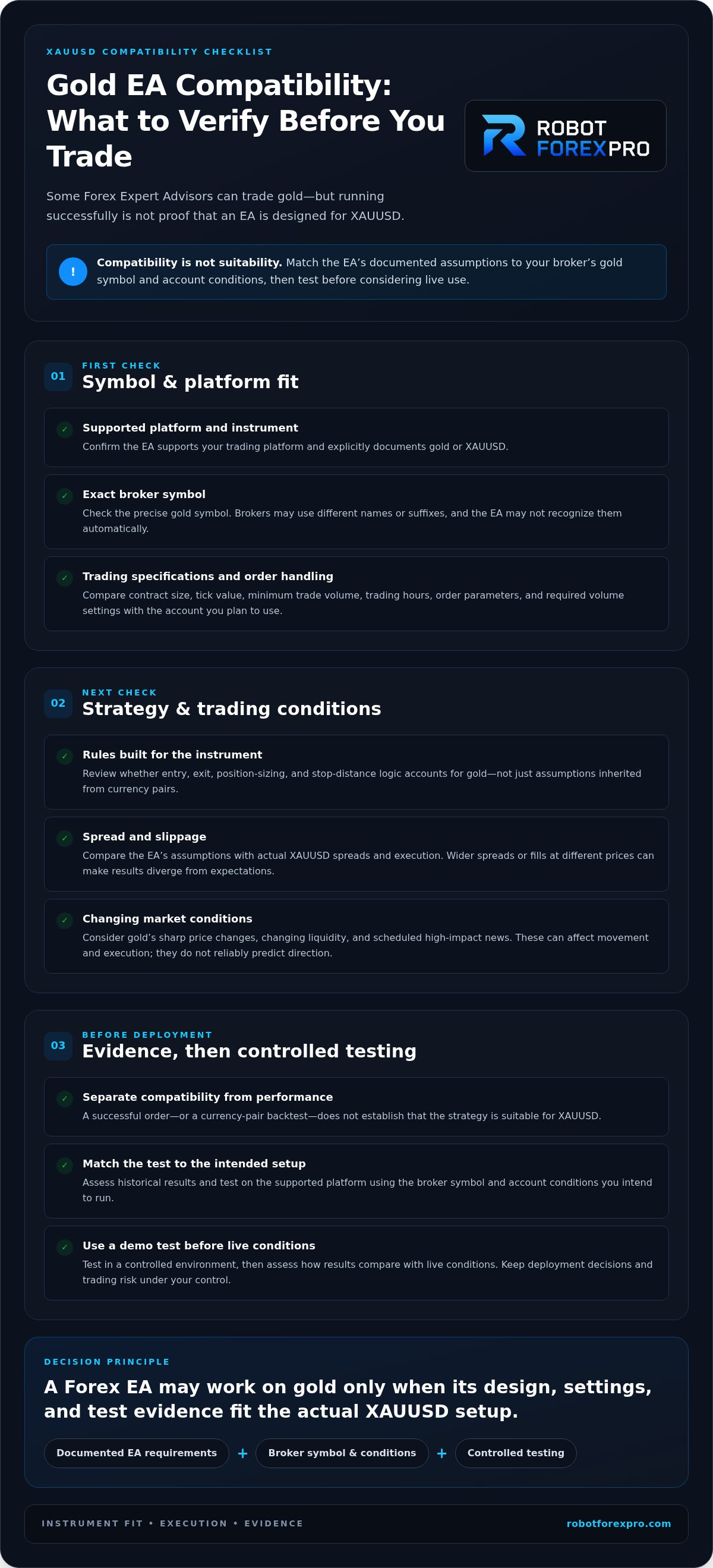
How to Evaluate a Gold EA Before Using It
Evaluate a gold EA in stages. First verify its documented scope and setup. Next, test it in a controlled environment using the intended symbol, platform, and broker conditions. Then compare its behavior with live execution conditions. This process can reveal compatibility problems and gaps between assumptions and observed results. It can’t remove trading risk or guarantee performance.
A practical pre-deployment checklist
Record the exact configuration before testing. Include:
- The broker’s precise gold symbol, including any suffix.
- The trading platform and version, plus the account type.
- Relevant symbol and account specifications, such as contract details, tick value, minimum trade size, spread, and trading hours.
- The EA’s documented instrument scope, required settings, and operating conditions.
- The exposure limits you’ve set for the account before enabling automated orders.
Compare these details with the EA documentation. If the stated setup doesn’t match your symbol, platform, or account conditions, don’t treat a successful installation as proof of compatibility. Resolve the mismatch before testing. Set exposure limits based on your own financial circumstances and risk tolerance. There isn’t a universal limit that makes an automated gold strategy safe.
What to observe during demo and live evaluation
Start with a demo account or another controlled test environment. Check whether entries, order sizes, and exits behave as documented. Record trade frequency, drawdown, spreads at execution, slippage, and any rejected or delayed orders. Compare actual behavior with the strategy description, not just with its expected profit.
A backtest is a simulation using historical data and assumptions. Its results can differ from live execution because prices, spreads, slippage, and other trading conditions may not match the test. A demo test can show how the EA operates in a simulated environment, but it may not reproduce every condition of a live account. Treat each stage as evidence with limits, not as a promise about future results.
If observed orders or risk behavior materially differ from the documented strategy, pause deployment and investigate the cause. Don’t increase exposure to compensate for unexpected results. Account access, configuration, and trading decisions remain your responsibility, including whether to proceed after testing.
Ready to assess a purpose-built option against your setup? Explore gold-focused EA software and review its documented requirements before testing.
Choosing a Gold-Focused Expert Advisor: RobotForexPro Options
Once you’ve established what an EA needs to support and how you’ll evaluate it, compare software options with your intended XAUUSD setup. RobotForexPro offers two gold-related Expert Advisors: RFP GoldenStar EA, identified as a gold trading product, and RFP Gold V5.7 EA, identified as XAUUSD-focused software.
These product descriptions provide a starting point, not a substitute for reviewing each EA’s operating requirements. Suitability depends on your platform, broker symbol, account conditions, trading objectives, and risk tolerance. Don’t assume either system will work with every broker or account, or that a gold-related label establishes compatibility or future performance.
How RobotForexPro’s gold EA options fit the decision framework
Apply the same checks to both options. Review the product information for its supported instrument, required platform, symbol naming, settings, and stated operating conditions. Compare those details with your actual setup before testing. If the documented setup doesn’t match, pause rather than treating installation or order placement as proof that the system is operating as intended.
Then evaluate the software in a controlled environment. Observe whether order behavior aligns with the documented strategy, and keep track of execution differences and account exposure. A test can inform your decision, but it can’t establish how the EA will perform under every future market condition.
The next step: review the software and its operating requirements
An Expert Advisor is software that traders deploy independently. RobotForexPro sells automated trading software, not brokerage or managed-account services, and the software doesn’t guarantee investment returns. You retain responsibility for account access, configuration, deployment, and trading risk. Buying or running an EA doesn’t transfer control of your account or remove the possibility of loss.
Before deployment, read the product information and operating requirements, match them to your platform and broker’s XAUUSD symbol, and test before considering live use. Base your decision on documented setup details and observed behavior, not the product name alone.
Explore RobotForexPro gold trading software
Make Your XAUUSD EA Decision With Evidence
So, does forex ea work for gold? Some EAs can trade XAUUSD, but technical compatibility isn’t proof that the strategy fits gold or your account. Confirm the documented symbol, platform, and broker conditions, then test in a controlled environment. Backtests and demo results can inform your assessment, but neither guarantees live performance or removes trading risk.
RobotForexPro offers two gold-related software options: RFP GoldenStar EA and RFP Gold V5.7 EA. Review their product information and operating requirements against your setup before deployment. RobotForexPro sells proprietary automated trading software for independent traders, not brokerage or managed-account services. You retain responsibility for account access, deployment, and trading risk.
Take the next step with a clear evaluation plan. Review RobotForexPro gold trading software, compare the requirements with your intended setup, and proceed at a pace that keeps your risk decisions in your hands.
Frequently Asked Questions
Can a Forex EA trade gold?
Yes, some Forex EAs can trade gold if their design supports the broker’s gold symbol and trading specifications. An EA may be able to send XAUUSD orders without having a strategy designed for gold, so technical compatibility alone isn’t enough. Check the documented instrument, platform, required settings, and operating conditions, then test that exact setup. Compatibility doesn’t establish profitability or mean the risk is appropriate for your account.
Is XAUUSD the same as a Forex currency pair?
No. XAUUSD represents gold priced against the US dollar. It’s a precious metal quoted against a currency, not a pair of two currencies. That distinction matters because an EA’s trading rules and assumptions may be built around currency-pair behavior. Gold’s price can respond to factors such as US dollar movements and changing market expectations. Check how the EA handles the instrument instead of assuming its currency-pair logic transfers unchanged.
Do I need a gold-specific EA to trade XAUUSD?
Not necessarily. A general Forex EA may support XAUUSD, but its documentation should explicitly cover the instrument and the setup you intend to use. A gold-focused EA may be designed for gold, yet the label alone doesn’t prove compatibility, quality, or suitability. Compare the supported symbol, platform requirements, settings, strategy description, and available test evidence before deciding. No EA is automatically right for every broker, account, or trading objective.
Can I use the same settings for Forex and gold?
Don’t assume Forex settings are suitable for gold. Broker specifications such as contract size, tick value, minimum trade volume, spread, and symbol naming can differ. Those differences can affect order size, exposure, and execution. Compare the EA’s documented settings with your broker’s exact XAUUSD symbol and account specifications. Change settings only in line with the system documentation, then test the configured setup before considering live deployment.
How can I test whether a Forex EA works on gold?
Start by matching the EA’s documented requirements to the gold symbol, platform, and broker account you plan to use. Review backtests as simulations, not predictions, and check the assumptions behind the historical data and execution costs. Then test in a demo environment. Observe whether orders, exits, trade size, and frequency behave as described, while monitoring drawdown and execution differences. Testing can reduce uncertainty, but it can’t remove trading risk.
Is automated gold trading profitable?
It can’t be assumed to be profitable. Results depend on the strategy, market conditions, trading costs, and execution, and past or simulated performance doesn’t guarantee future outcomes. Evaluate evidence carefully, including the test method, period, and account conditions. Set exposure limits before testing and decide what behavior would cause you to pause. Automated trading software executes programmed rules; it doesn’t guarantee returns or remove your responsibility for account access and trading risk.