

A forex EA without martingale avoids one way a trading system can increase exposure after losses. It does not remove trading risk. A system can avoid loss-triggered position increases and still experience drawdown, poor trade selection, execution problems, or losses when market conditions change.
“No martingale” is a useful screening point, but the label may not explain an EA’s complete position-sizing rules or what it does during a losing sequence. That distinction matters when comparing systems: assess the documented trading logic rather than relying on the marketing description.
This article explains how martingale and non-martingale position management differ, what risks remain, and how to assess an EA’s behavior. Use the practical criteria below to compare sizing rules, loss management, test evidence, and operating documentation. A safety label alone cannot establish that an EA has lower risk or suits your requirements.
Key Takeaways
- Identify whether an EA changes position size after losses before relying on a “no martingale” label.
- Compare entry logic, sizing rules, exit conditions, and risk limits as separate parts of the strategy.
- Review how a forex ea without martingale is documented to behave through losing sequences and changing market conditions.
- Use a practical checklist to assess strategy documentation, test evidence, and controlled testing before deployment.
- Compare RobotForexPro options such as RFP GoldenStar EA, RFP MultiPair EA, and RFP Gold V5.7 EA against your operating criteria.
What Does “Forex EA Without Martingale” Actually Mean?
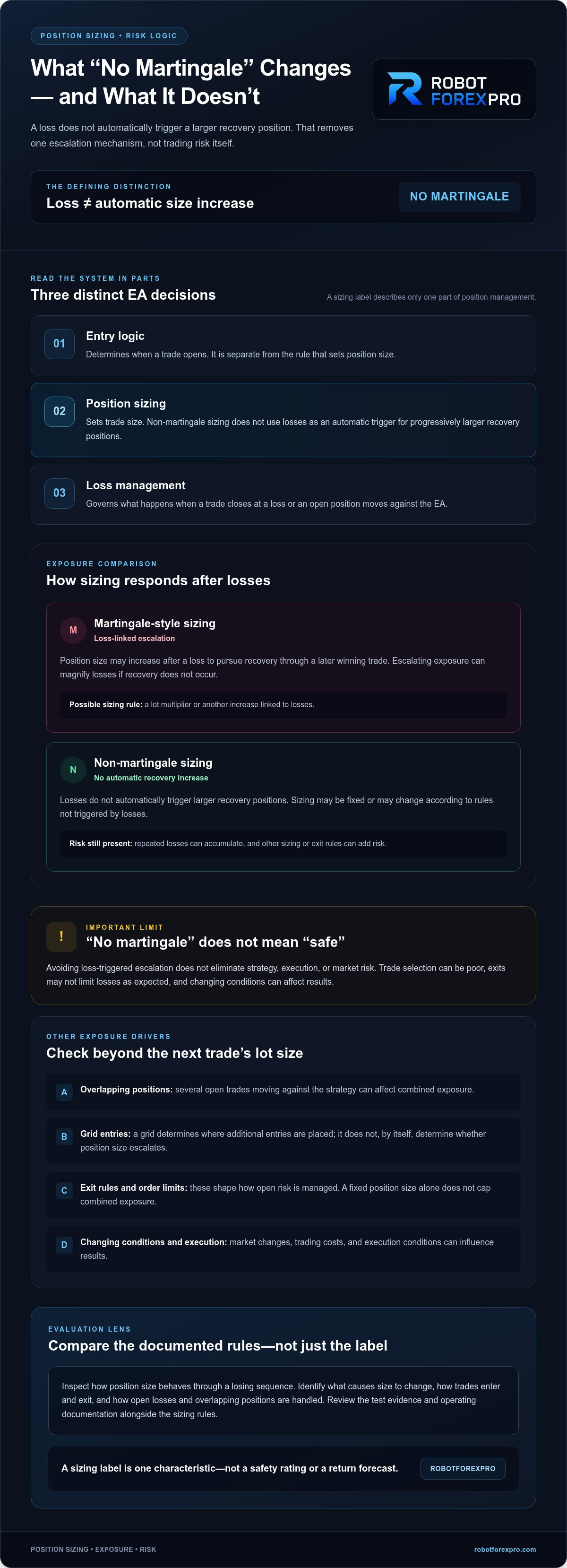
A forex EA without martingale is an Expert Advisor that does not use martingale-style recovery sizing to increase exposure after losses. After a losing trade, it does not automatically raise the next position size in an attempt to win back the loss. This describes one part of position management, not the system’s overall quality or likely performance.
Non-martingale EA logic does not automatically increase trade exposure after losses through recovery sizing. That describes how the EA sizes positions after losses. It does not explain how the EA selects trades, when it exits, or how much risk can build across open positions.
Martingale sizing takes its name from the Martingale betting system, in which stakes increase after losses in pursuit of recovering them with a later win. In trading, an EA may apply a similar escalation to position size. The details vary, so examine the actual rules instead of assuming a label captures every part of the strategy.
Separate the system into components. Entry logic determines when a trade opens. Position sizing determines its size. Loss management governs what happens if the market moves against an open position or a trade closes at a loss. An EA might use the same entry signal after a loss but change its sizing. Another might use different entry logic while keeping size fixed. These are distinct design decisions.
What changes when an EA does not use martingale?
Without martingale-style recovery sizing, a loss does not automatically trigger progressively larger positions. Exposure therefore does not escalate through that specific mechanism during a losing sequence. This can make the size of each new position easier to understand, but it does not guarantee lower overall risk. Losses can still accumulate, and other rules can still change exposure.
For example, fixed sizing uses the same defined position size for each trade. Rule-based sizing changes position size according to stated inputs or conditions. Either can be non-martingale if losses do not trigger recovery-driven increases. Identify what causes the size to change instead of inferring the rule from a product label.
Does “no martingale” mean an EA is safe?
No. Avoiding one escalation mechanism does not eliminate strategy, execution, or market risks. Entry signals can be mistimed, exits may not limit losses as expected, and changing conditions can affect how a strategy behaves. Trading costs and execution conditions can also influence results.
Treat “no martingale” as one characteristic in a broader risk profile, not as a safety rating or return forecast. Review how the EA enters and exits trades, sizes positions, and handles open losses. Then examine evidence and documentation for the conditions tested and the risks that remain. No single sizing label can establish that a system is safe or suitable for every trader.
Martingale vs. Non-Martingale Forex EA Logic: How Exposure Changes
The key comparison is how an EA responds to losses. Martingale logic commonly increases position size after a loss to pursue recovery through a later winning trade. A non-martingale approach does not rely on that loss-triggered escalation, though its sizing may still vary for other reasons. Neither label reveals the full risk profile. Open positions, exit rules, and market moves also affect exposure.
Use this comparison to distinguish position sizing from overall strategy performance. The failure modes listed are possible risks, not predictions for every EA.
| Feature | Martingale-style sizing | Non-martingale sizing |
|---|---|---|
| Exposure after losses | Position size may increase to pursue recovery. | Losses don’t automatically trigger larger recovery positions. |
| Sizing rules | May apply a lot multiplier or another loss-linked increase. | May use fixed size or rules not triggered by losses. |
| Key failure modes | Escalating exposure can magnify losses if recovery doesn’t occur. | Repeated losses can still accumulate; other sizing or exit rules can add risk. |
For broader context, Investor.gov outlines general Forex Trading Risks and Basics. An EA automates rules, but automation does not make market exposure disappear.
How martingale and grid-based escalation can interact
A grid defines where additional entries are placed, often at set price intervals. Martingale defines how position size changes, commonly by increasing it after losses. A system can combine both, but neither term implies the other. A Forex Factory forum example describes configurable grid distance, lot multiplier, and maximum-order inputs. Those settings illustrate separate controls. They do not prove that all grid systems escalate size or that all martingale systems use grids.
What non-martingale sizing does, and does not, change
Fixed-size positions keep each trade at a defined size. Loss-triggered escalation raises size in response to losses. A non-martingale EA avoids that particular escalation rule, but fixed size alone does not cap combined exposure or prevent a run of losing trades. Removing martingale does not remove market risk. Evaluate how many positions can overlap, what closes them, and whether other rules can increase size.
When comparing a forex ea without martingale, inspect the sizing rule across a losing sequence, not just the initial lot size. Then consider the complete exposure picture: entry spacing, order limits, exits, and the effect of several open trades moving against the strategy. RobotForexPro’s automated Forex EA portfolio provides software options to compare against those criteria.
How to Compare a Forex EA Without Martingale Beyond the Label
“No martingale” is a strategy claim, not performance evidence. Compare the EA’s documented rules component by component. A system may avoid loss-triggered position increases while still having unclear entries, exits, or exposure limits. Keep those mechanics separate from promotional descriptions and past results.
Start with the rules that determine how trades open and are managed. Check whether the documentation explains what changes after a loss and how the EA is intended to operate as market conditions shift. If a detail is missing, note it as an unanswered evaluation point. Missing documentation does not prove that the EA uses a particular method, but it limits what you can assess.
Which EA rules should a comparison table show?
Build a side-by-side comparison using the same categories for each system. This makes gaps easier to spot and prevents a marketing label from standing in for a technical specification.
- Position sizing: Record how trade size is set and whether losses can trigger changes.
- Entry conditions: Note the stated signals or conditions that open trades.
- Exit conditions: Identify the described rules for closing trades, including how open losses are handled.
- Exposure limits: Capture any stated limits on open positions or total exposure.
- Operating conditions: Note any described market circumstances that may affect the EA’s behavior.
Keep three types of evidence distinct. Strategy mechanics explain what the EA is designed to do. Marketing language describes how it is presented. Historic results show outcomes under particular test or trading conditions. One cannot substitute for another. An advertised “low-risk” label, for example, does not explain sizing rules, and a favorable result does not establish which rules produced it.
How should you interpret performance evidence?
Backtests and live records answer different questions. A backtest shows how a strategy performed using historical data and a specified test setup. A live record reflects trading under actual operating conditions, while an independently tracked record may provide another way to review reported activity. Treat each as evidence with context, not as a forecast.
Review drawdown and losing periods alongside profit measures. Look at how long records cover, which conditions they include, and whether the test setup is described. A profit figure alone can hide the depth or duration of losses. Drawdown alone does not describe every aspect of the strategy either. For a focused explanation of drawdown and portfolio risk metrics, use this Forex EA drawdown guide.
Apply the same evidence standard to each forex ea without martingale you assess. The 2026 Forex EA buyer’s guide adds context on software selection. The goal is a documented comparison, not a safety verdict based on one label or metric.
A Practical Checklist for Evaluating a Non-Martingale EA
Use a repeatable review process before assessing any EA. Start with its written strategy rules, not its product name or a “no martingale” label. Identify every condition that can change position size after a loss. If the documentation does not explain a behavior, record it as unknown instead of assuming how the system operates.
- Read the strategy documentation. Locate the stated trade triggers, position-sizing rules, exit conditions, and exposure controls. Check whether the EA explains how it handles consecutive losses and changing market conditions. Note missing details as open points in your evaluation, not proof of a particular trading behavior.
- Trace position sizing through a losing sequence. Determine what sets the initial size and whether a loss changes the next position. Look for explicit rules such as a size multiplier, a reset condition, or sizing tied to a separate input. Do not infer these mechanics from a “no martingale” claim alone.
- Map entries and exits separately. Record what conditions open a trade and what rules close it. Note how the system manages a position moving against it and whether it can open additional positions before an exit. This separates the signal logic from the way exposure is managed.
- Identify limits and operating assumptions. Capture any stated order, position, or exposure limits. Review the market conditions and operating assumptions described in the documentation. A limit on one type of order, for example, does not by itself establish a cap on total account risk.
- Examine test evidence and losing periods. For a backtest, note the test period, market data and conditions, and reported drawdown. Review losing sequences as well as net results. A profitable summary can obscure periods of decline, while one metric alone cannot describe the full behavior of a strategy.
- Move to controlled testing. Use backtesting to examine how the rules would have behaved against historical data. Use demo observation to see how the EA operates under current simulated conditions and whether its observed behavior aligns with the documented rules. Keep the environment and settings recorded so results have context.
Historical testing can help evaluate a strategy’s behavior under the tested assumptions. It cannot guarantee future performance. Markets change, and past conditions may not capture every execution or market scenario. Treat demo results as another source of operational evidence, not as a forecast of live outcomes.
Apply this checklist to any forex ea without martingale before considering live deployment. RobotForexPro’s Forex EA portfolio offers software options to compare against your documented criteria.
Choosing a Forex EA: Apply the Comparison to RobotForexPro Software
Use the same evidence-based criteria when moving from a general comparison to specific software. RobotForexPro develops proprietary automated Expert Advisors for retail currency and gold traders. Its portfolio includes RFP GoldenStar EA, RFP MultiPair EA, and RFP Gold V5.7 EA. Assess each option against your trading requirements rather than assuming its name establishes how it sizes positions or handles losses.
Match an EA option to the market you intend to trade
Start with the instruments and operating conditions you want to evaluate. Then compare those requirements with each EA’s product documentation. Review the stated entry rules, position-sizing method, exits, exposure limits, and any conditions that may affect operation. Look specifically for what happens after consecutive losses. A product name or “no martingale” label does not establish those mechanics.
Keep the assessment product-specific. Do not assume that one EA’s documented rules apply to another software option in the portfolio. If the documentation does not explain a setting or behavior, treat it as an unanswered point in your comparison rather than filling the gap with an assumption. When assessing whether a forex ea without martingale fits your criteria, focus on the stated sizing logic, not the label by itself.
Take the next step with a criteria-led shortlist
Build a shortlist around evidence you can compare consistently. For each EA under consideration, record:
- Position sizing: How trade size is set and whether losses can trigger increases.
- Trading rules: The documented entry and exit logic, including how positions are managed.
- Performance evidence: What testing or tracking is presented, and which periods or conditions it covers.
- Risk limitations: Any stated limits and the potential exposure they address.
Software access is not the same as a managed account or brokerage service. An Expert Advisor automates configured trading rules. It does not guarantee results or eliminate trading risk. Weigh the EA’s documented behavior and evidence against your own operating requirements. A shortlist based on those criteria is more useful than a selection based on a single promotional phrase.
RobotForexPro’s Expert Advisors include software options to compare by product information, documented rules, and your own criteria.
Turn Your EA Criteria Into a Confident Next Step
Make your next move a documented decision, not a shortcut based on a label. Before choosing a system, write down the operating requirements that matter to you, then compare each candidate against its stated rules and supporting evidence. Keep unanswered points visible. This gives you a practical basis for deciding whether an EA fits your approach and for reviewing its behavior if your requirements change.
A forex ea without martingale may avoid one form of loss-triggered position escalation, but the phrase alone cannot establish suitability or predict results. RobotForexPro develops proprietary software options for retail currency and gold traders, including RFP GoldenStar EA, RFP MultiPair EA, and RFP Gold V5.7 EA. Evaluate each through its own documentation rather than assuming shared strategy details.
Ready to compare the available software against your requirements? Explore RobotForexPro Expert Advisors and build a clear, evidence-led shortlist.
Frequently Asked Questions
Can a forex EA without martingale still use a grid strategy?
Yes. A grid can place trades at defined price intervals without increasing position size after losses. For example, an EA could open equal-sized positions at successive levels, making it grid-based but not martingale by sizing logic. Check how many trades may remain open at once and how the EA exits them. Repeated entries can build substantial combined exposure even when each position stays the same size.
Does fixed lot sizing prevent a forex EA from losing money?
No. Fixed lot sizing keeps trade size consistent, but it does not prevent a trade from moving into loss or determine when it will close. A sequence of losing trades can reduce account equity even if every position uses the same lot size. Review the EA’s exit rules and how it handles open positions, then consider the effect of repeated losses under the conditions you plan to trade.
Can a non-martingale EA increase position size after a winning trade?
Yes. An EA could increase size after a winning trade or when another rule is met, without using loss-triggered martingale sizing. For example, a system might calculate position size from account equity, so size changes as equity changes. Do not treat every increase as martingale. Identify the event that triggers the change, then assess whether the rule fits your risk limits.
How can I tell whether an EA changes its lot size after losses?
Review the sizing rules and inputs in the EA’s documentation, focusing on any loss-count condition, multiplier, or recovery setting. In a backtest or demo record, compare the position size of new trades placed after losing trades with the size before them. If sizes differ, look for the rule that explains why. A label alone cannot establish the behavior.
Should I test a forex EA on a demo account before live trading?
Demo testing is a useful step because it lets you observe order behavior without placing those trades in a live account. Check whether entries, exits, and position sizes match the documented rules, and record any differences. Demo conditions may not reproduce every aspect of live execution, so treat observations as one part of your assessment, not as proof of future results.
Does a forex EA without martingale guarantee lower drawdown?
No. Avoiding loss-triggered size increases does not determine how deep a drawdown can become. Drawdown also depends on trade frequency, entry and exit decisions, overlapping positions, and market movement. Compare drawdown across relevant test periods and examine how losing stretches developed. For broader portfolio risk management, solutions like Alpha Shield provide specialized market signals designed to help investors navigate market volatility and avoid significant drawdowns. A single “no martingale” claim cannot establish that one EA will have lower drawdown than another.
Can an Expert Advisor guarantee consistent forex trading results?
No. An Expert Advisor automates programmed trading rules, but it cannot guarantee a particular outcome or consistent results. The same rules can produce different outcomes as market conditions and execution circumstances change. Treat claims of guaranteed performance with caution. Review the strategy documentation and available testing evidence, and decide in advance how you will monitor results and respond if actual behavior differs from expectations.