

A forex robot’s biggest return can be its least useful number. To understand how to evaluate forex robot performance, look past the headline and test whether the results are transparent, consistent, and relevant to the conditions you plan to trade.
It’s reasonable to want clear evidence before trusting an Expert Advisor. But backtests and live accounts aren’t automatically comparable. Broker spreads, slippage, leverage, and execution can change observed results, while a strong-looking return may hide deep drawdowns or uneven performance.
This guide gives you a repeatable way to assess an EA before testing it independently. You’ll learn how to distinguish account evidence from promotional claims, interpret returns alongside drawdown, win rate, and profit factor, and account for execution conditions. You’ll also see why a backtest is useful evidence, but not a substitute for examining live trading history and the settings behind it. The goal is to make a disciplined decision based on risk and repeatability, not one impressive percentage.
Key Takeaways
- Learn how to evaluate forex robot performance with a repeatable process, from defining your objectives to documenting results.
- Read net return, maximum drawdown, trade count, and record duration together to build a more complete performance picture.
- Compare backtests, demo results, and live records by examining how each source was produced and what it can reveal.
- Set risk limits and use consistent testing conditions to make comparisons more meaningful.
- Use evidence quality, risk profile, and trading fit to decide whether to proceed, pause for more information, or reject an EA.
How to Evaluate Forex Robot Performance Before Trusting the Results
An impressive return can attract attention, but it can’t establish that a forex robot is reliable. The figure may describe a short period, a simulation, or one specific account setup. To understand how to evaluate forex robot performance, examine more than the profit: look at the supporting evidence, the risks taken, and whether the results fit your intended use.
A forex robot, also called an Expert Advisor (EA), is software that can execute trades according to programmed rules. That differs from a managed account, where another party makes trading decisions for you, and from a guaranteed-return investment. An EA’s historical or advertised performance is not a promise of future results.
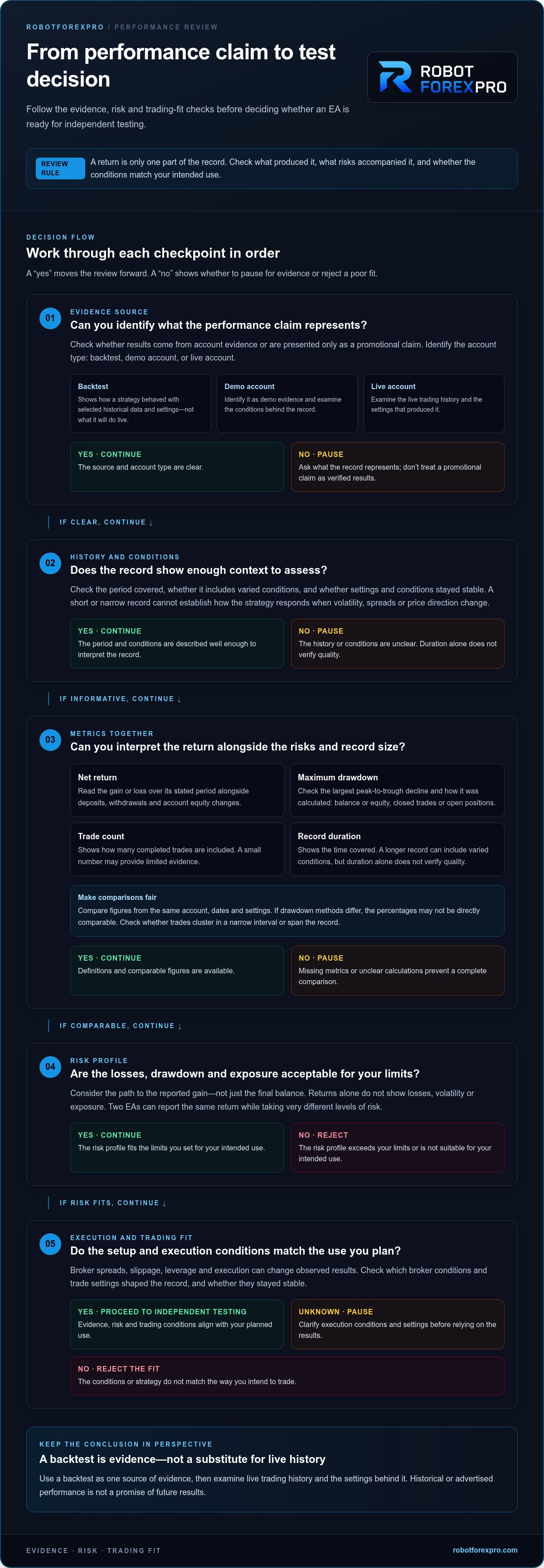
Start by establishing what a performance claim actually represents. Use this checklist to assess the evidence:
- Source: Is the record supported by account evidence, or presented only as a promotional claim?
- Account type: Did the results come from a backtest, demo account, or live account?
- History: What period does the record cover, and does it include varied conditions that make it informative?
- Risk: What losses, drawdowns, and exposure accompanied the reported gains?
- Execution: Which broker conditions and trade settings shaped the results?
- Consistency: Were the settings and conditions stable throughout the record?
What does forex robot performance actually mean?
Performance means the outcomes produced by a particular strategy under particular conditions. Separate realized trading results from marketing claims and simulated projections. A simulation shows how a strategy behaved with selected historical data and settings. It doesn’t prove what would happen in a live account. The broader concept of algorithmic trading helps explain how software follows rules to place trades, but the strategy’s results still need to be assessed on their own evidence.
Returns are only one part of that record. Losses, volatility, and exposure show what the system experienced on the way to its gains. Two EAs might report the same return while taking very different levels of risk. Consider the full path of results, not just the final balance or a favorable snapshot.
Why one headline return cannot settle the question
A return figure without context leaves basic questions unanswered: over what period was it earned, what was the starting balance, and how much risk did the strategy take? For example, a hypothetical 20% gain over a brief interval can’t be compared directly with the same gain over a longer record. The percentage alone doesn’t reveal the sequence of gains and losses or the conditions behind them.
Short records may capture only a narrow set of market conditions. They can’t establish how a strategy responds when volatility, spreads, or price direction change. Treat a headline number as a reason to inspect the evidence, not as a verdict. Past performance does not guarantee future results.
Use the checklist as a filter before comparing metrics or testing systems. If the source, account type, history, risk, execution conditions, or settings are unclear, the results may not be relevant to your planned use. Pause and identify what’s missing. A disciplined evaluation begins by defining what the evidence can support, and what it cannot.
Which Forex Robot Performance Metrics Should You Examine Together?
A performance record becomes useful when you read its metrics as a group, not as isolated scores. Net return shows the outcome; drawdown shows a key part of the cost; trade count and record duration help explain how much evidence supports the result. This combined view is central to how to evaluate forex robot performance without mistaking a strong-looking figure for a complete assessment.
Net return: The account’s reported gain or loss over a stated period. Read it alongside deposits, withdrawals, and changes in account equity.
Maximum drawdown: The largest decline from an equity or balance peak to a later trough during the measured period. The calculation method matters.
Trade count: The number of completed trades in the record. It helps show how many outcomes are included.
Record duration: The length of time covered by the results. A longer record can include more varied conditions, but duration alone doesn’t verify quality.
These metrics answer different questions. A robot might report a high net return, but a deep drawdown could indicate substantial risk along the way. A low drawdown based on a small number of trades may offer limited evidence. Compare the figures together, and check that they cover the same account, dates, and settings.
How should you interpret return, drawdown, and trade history?
Start by tying net return to the exact period and account equity changes. Deposits and withdrawals can alter the displayed balance without representing trading gains or losses. Then inspect drawdown: note whether it’s calculated from balance or equity, and whether it reflects closed trades or open positions. Compare trade count with the trading pattern. Frequent trading isn’t inherently better, and a small number of long-held positions can shape results differently.
A useful comparison preserves these definitions. If two reports calculate drawdown differently, their percentages may not be directly comparable. Trade history can also reveal whether activity is clustered in a narrow interval or spread across the record. A headline return without these details leaves important context unresolved.
What do risk-adjusted measures add to the evaluation?
The Sharpe ratio compares return with the variability of those returns. It can help distinguish smoother performance from more volatile results, but it’s not a verdict or a forecast. The calculation period and data quality affect its interpretation. Nurp’s Five Most Important Metrics for Evaluating Automated Trading Systems also discusses risk measures that can add context to a broader review.
Ratios don’t remove the need to inspect exposure. Leverage can amplify both gains and losses, while open trades may make current equity risk look different from closed-balance results. Deposits and withdrawals may also affect displayed performance, depending on how the account statistics are calculated. Check the reporting method before comparing accounts, and don’t rely on a universal pass mark without a clear methodology.
For a consistent review, record each metric with its dates, account type, calculation basis, and relevant equity changes. Apply the same framework to any EA you assess, including systems in the RobotForexPro Expert Advisor range. No single statistic settles the decision. Together, the metrics show what a result represents and where its limits remain.
How to Compare Forex Robot Backtests, Demo Results, and Live Records
Backtests, demo accounts, and live records answer different questions. A backtest asks how a strategy would have performed on historical data under specified assumptions. A demo account shows how it behaves in a simulated environment. A live account records trading with real capital under actual account conditions. None is a complete forecast, so compare the evidence source and its limits before drawing conclusions.
- Backtest: Useful for examining historical behavior, but dependent on data quality, assumptions, and test settings.
- Demo account: Useful for observing an EA’s operation without risking real capital, but simulated execution may differ from live trading.
- Live account: Shows results from real trading conditions, but still reflects a particular account, broker setup, and observation period.
What can a backtest tell you, and what can it not prove?
A backtest can reveal how a strategy behaved across the historical data and settings used. Check whether the data period, assumptions, and key test settings are disclosed. Without those details, it’s difficult to reproduce or interpret the result. A backtest cannot establish that the same conditions will recur in live trading.
Overfitting is a key limitation: a strategy can be tuned to fit old data yet fail to generalize to unseen market conditions. Treat a polished historical curve as a hypothesis to investigate, not proof of future performance. Detailed testing procedures belong in a dedicated backtesting guide.
How do you inspect a live or demo track record?
First identify whether the account is live or demo. Then note the observation period and check that the record is updated consistently. Review the available trade history and visible open positions, since open trades matter when a closed-trade summary doesn’t show current exposure. Compare the account’s stated conditions with the environment in which you plan to use the EA.
Platforms such as Myfxbook and FX Blue can help display and track account information. Third-party tracking may help you check whether account data aligns with the published record, depending on the platform and verification shown. It doesn’t independently prove that a strategy is suitable, that every relevant detail is visible, or that future results will match.
Use the records comparatively. If a backtest looks strong but the demo record behaves differently, investigate the data, test assumptions, settings, and execution conditions rather than averaging the results into one score. If a live record is available, assess its duration and account context instead of treating “live” as a quality stamp. These distinctions make how to evaluate forex robot performance more evidence-led: label each record by source, identify what it can support, and keep its limitations attached to your conclusion.
For a disciplined comparison, retain the source and date of each record alongside its account type, settings, and observation period. This creates a clear audit trail and helps prevent a backtest, demo result, and live history from being treated as interchangeable evidence.
How to Run a Practical Forex Robot Performance Evaluation
A repeatable evaluation starts before the first trade. Set your criteria in advance, keep conditions stable, and record what changes. This helps separate an EA’s observed strategy behavior from differences caused by broker execution or account setup.
Set evaluation criteria before testing an EA
Define the account’s purpose, the level of risk you’re prepared to accept, the review period, and a comparison baseline. Record the platform, instrument, account type, EA settings, and material execution conditions, including spreads and observed slippage. Choose these criteria before reviewing results, so a short run of profit doesn’t quietly change your definition of success.
- Define the objective. State what the EA needs to demonstrate for your intended use. Set a review schedule and select a relevant baseline for comparison.
- Audit the evidence. Record the source of the performance data, account type, history covered, settings, and any reporting gaps. Separate observed account results from simulations or promotional claims.
- Set risk boundaries. Decide in advance what level of account fluctuation or drawdown would prompt a pause or reassessment. Keep position-sizing decisions within your own risk plan rather than changing them to improve a test result.
- Test under consistent conditions. Use the same platform, instrument, account type, and execution setup when comparing systems. Change one setting at a time if you need to understand its effect. Changing several together makes cause and effect difficult to isolate.
- Review and document. At each scheduled interval, record account equity, drawdown, trade behavior, and execution differences. Compare your observations with the original criteria, then note the decision and the reason for it.
Review outcomes without overreacting to short-term noise
Use a written log, not memory. Include review dates, EA settings, relevant account changes, and unusual execution conditions. A brief change in results can reflect normal variation, altered market conditions, or differences in spreads or slippage. These execution factors affect the prices and costs at which orders are filled. They aren’t automatically evidence that the EA’s strategy has changed.
If results diverge from expectations, investigate in sequence. Check whether settings changed, whether account conditions stayed comparable, and whether open trades or execution differences explain the observation. Treat unexpected behavior as a reason to examine the record, not as proof of fraud. Avoid changing several variables or drawing a firm conclusion from a brief observation window.
This process turns how to evaluate forex robot performance into a controlled review rather than a reaction to the latest return. Apply the same criteria to each system, including the Forex Expert Advisors from RobotForexPro, and keep the evidence trail intact. To assess an EA for independent use, explore RobotForexPro’s Expert Advisors and apply your criteria before deployment.
How to Choose and Assess a Forex EA for Independent Use
A sound decision follows from the evidence, not from a ranking or a return claim. Use three outcomes: proceed when the record is understandable, the risk profile fits your criteria, and the EA’s purpose aligns with your intended use; pause when key details remain unresolved; reject claims built around guaranteed profits or concealed risk.
This is a decision about software for independent use. An EA can execute trades according to its programmed strategy, but you remain responsible for whether to deploy it, what account conditions to use, and how to monitor it. No evaluation can remove market risk or guarantee that past behavior will continue.
When should you continue testing, pause, or reject a robot?
Continue only if you can understand the evidence and compare it with the criteria you set before testing. Check that the account history, reported risk, and execution context are relevant to your intended setup. Continuing the evaluation is not an endorsement of future results. It means the available evidence justifies the next stage of your own review.
Pause if the record’s account type, open exposure, observation period, or execution assumptions are unclear. Identify what information is missing before relying on the claim. Reject claims that promise guaranteed profits or obscure material risk. They don’t provide a sound basis for an independent trading decision.
Match the EA category to the strategy you want to evaluate
Strategy fit matters. Decide whether you want to assess a system designed around a particular market category or one associated with multiple currency pairs, then judge its evidence against that purpose. For example, RFP GoldenStar EA and RFP Gold V5.7 EA are gold-focused examples, while RFP MultiPair EA is a multi-pair example. These categories describe the products, not their performance or suitability for every trader.
Use the same evidence framework for each candidate: establish what the record represents, understand risk alongside return, and compare the strategy’s focus with your intended use. A product name or category is not a substitute for account evidence. For broader software-selection context, consult a forex EA buyer’s guide alongside this performance review.
RobotForexPro develops and sells proprietary Forex Expert Advisors for independent customer use. Its range includes RFP GoldenStar EA, RFP MultiPair EA, RFP Gold V5.7 EA, RFP AlphaHype EA, RFP JapanStrike EA, RFP EuroStable EA, and RFP SmartProfit EA. Assess each system by the same standards you apply to any EA, and base deployment choices on your objectives, risk limits, and observations. Explore RobotForexPro’s Forex Expert Advisors as you identify options for further evaluation.
Make Your Next EA Decision Evidence-Led
Turn your evaluation into a decision you can explain. Keep your criteria and records available, then use them to guide your next step rather than reacting to the latest result. That discipline makes how to evaluate forex robot performance useful beyond a single review: it gives you a consistent standard for assessing systems as your goals and trading conditions evolve.
RobotForexPro develops and sells a portfolio of proprietary Expert Advisors for independent trade execution. Consider the available systems as candidates for your own evidence-based assessment, not as promises of a particular outcome. Trading involves risk, and no EA can guarantee returns.
Ready to explore the software options? Explore RobotForexPro’s Expert Advisors, then apply your criteria before making a deployment decision. A clear process keeps the decision in your hands and gives you a stronger foundation for what comes next.
Frequently Asked Questions
How do you evaluate a forex robot's performance?
A practical approach to how to evaluate forex robot performance is to match account evidence to your intended setup, not to rank systems by profit alone. Confirm the record’s source, dates, live or demo status, trade history, returns, drawdown, and execution conditions. Then run a structured trial with predefined review points and log any changes. This can show whether the EA’s behavior fits your criteria. Historical data and trial observations can’t guarantee future results.
What is the most important metric for a forex robot?
No single metric is decisive. Return shows the reported outcome, maximum drawdown helps reveal the size of declines, and record duration and trade count indicate how much history supports the result. Risk-adjusted measures add another view of variability relative to returns. Interpret these figures together, then account for leverage, account conditions, and your own risk tolerance. A statistic that looks favorable in isolation may not fit your trading objectives.
Can a forex robot's backtest predict live performance?
No. A backtest estimates how a strategy would have behaved using specified historical data and assumptions; it doesn’t predict what a live account will earn. Results can be less relevant if data quality is weak or settings are overfit to past price action. Live execution also introduces differences such as spreads and slippage. Use a backtest as one input, and examine its methodology before treating it as evidence for further testing.
Is a verified forex robot track record proof that it will make money?
No. Verification can support the accuracy of reported account activity, but it doesn’t establish future profitability. Market conditions may change, and broker execution, account settings, and risk exposure can differ from the record you reviewed. Inspect how long the account has been tracked, its drawdown, any open positions, and what the reporting covers. Treat verification as evidence about the record, not a forecast or assurance of future results.
How long should you evaluate a forex robot before using it?
There’s no universal evaluation period that suits every EA. Set a review window that allows you to observe enough trades and relevant market conditions for the strategy’s activity level. A system that trades infrequently may need more calendar time to produce useful observations than one with frequent activity. Define the criteria before testing and assess them at scheduled intervals. Even a longer record can’t eliminate uncertainty or trading risk.
What is the difference between a demo and live forex robot account?
A demo account trades with simulated funds; a live account exposes real capital to gains and losses. Demo testing can help you observe whether an EA opens and manages trades as expected without putting trading capital at risk. But execution and account conditions may differ, so demo results don’t establish identical live outcomes. Always interpret reported performance in light of the account type and the conditions under which it was produced.
Can a forex robot lose money even when its backtest is profitable?
Yes. A live EA can lose money even if its backtest shows a profit. Historical assumptions may not match future markets, and actual spreads, slippage, or other execution differences can affect trade results. Before deciding whether to test a system further, examine its drawdown, the assumptions behind its simulation, and the quality of its supporting evidence. A profitable historical result is not proof of live profitability or a guarantee against losses.