

A Myfxbook verification badge can validate account evidence. It cannot certify that a verified myfxbook gold ea will keep performing. That distinction matters when a polished chart makes risk look smaller than it is.
It’s reasonable to look for third-party verification before trusting a track record. But account verification and EA verification aren’t the same thing: Myfxbook can confirm account data and trading privileges, not guarantee which software produced every result or how it will perform next. A real account, a long history, and strong gains still need context.
This guide explains what Myfxbook’s verification labels do and don’t establish, then offers a practical framework for comparing gold EA records. You’ll learn to check absolute gain, drawdown, trade activity, account type, and evidence of real trading conditions, rather than relying on headline returns. You’ll also see how execution details and risk-heavy strategies affect comparisons. Use the same checks to assess gold EA options, including RFP GoldenStar EA and RFP Gold V5.7 EA, without treating past performance as a promise.
Key Takeaways
- Separate account verification from EA verification: Myfxbook checks account evidence, not the software’s future performance.
- Assess a verified myfxbook gold ea by reviewing its verification labels, account identity, history, and visible settings together.
- Compare track records only when the reporting periods, drawdown context, and trading conditions are clear enough to make the comparison meaningful.
- Use an account record as evidence, not a complete view of an EA’s settings, code decisions, or trading risk.
- Apply the same evidence checklist to gold EA software options, then compare their documentation and operating requirements with your setup.
What does a verified Myfxbook gold EA result actually mean?
A Myfxbook verification badge applies to account information. It does not certify the Expert Advisor (EA) that may have traded the account. Put simply: account verification checks specified account evidence; independent EA validation examines the software and its behavior. Those are different forms of scrutiny.
This distinction matters when searching for a verified myfxbook gold ea. A verified account can provide useful evidence about recorded trading activity and account control. It doesn’t establish that an EA’s code is sound, that the strategy is effective, or that its results will continue.
What Myfxbook verification checks, and what it does not
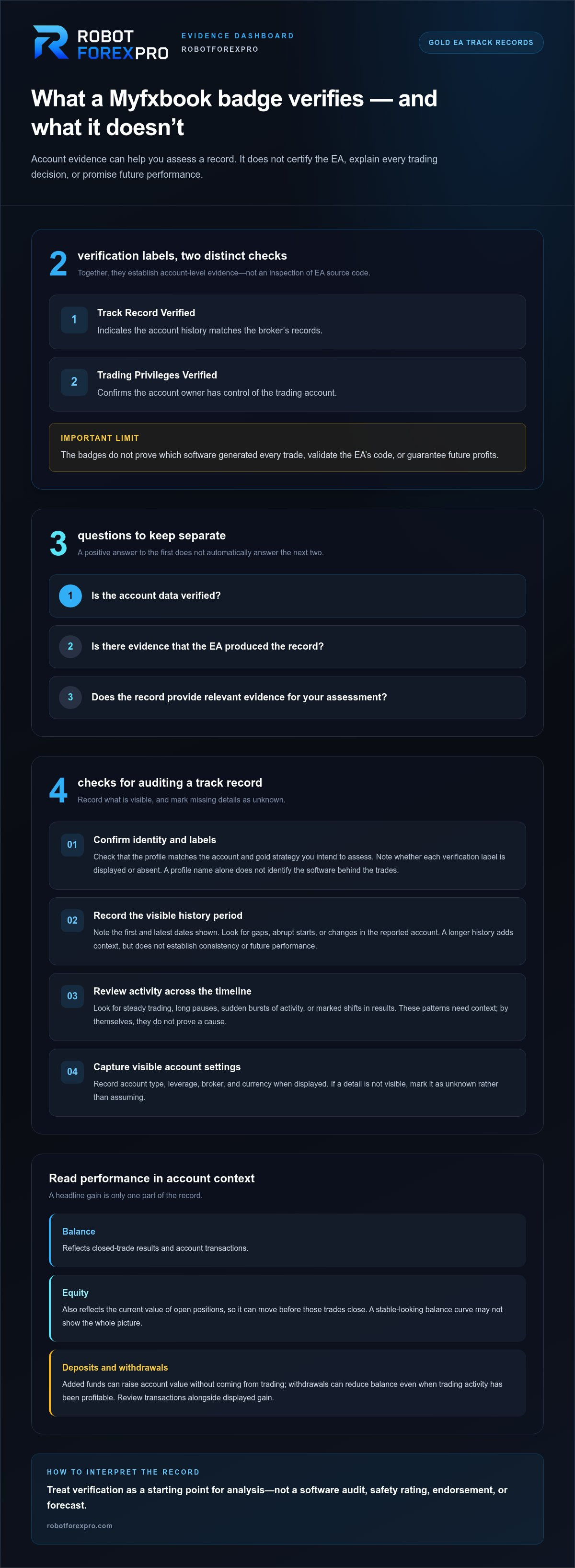
Myfxbook’s two main verification labels address separate checks. Track Record Verified indicates that the account history matches the broker’s records. Trading Privileges Verified confirms that the account owner has control of the trading account. Together, these labels help establish account-level evidence. They are not an inspection of the EA’s source code.
An EA automates trading decisions through programmed rules, a form of algorithmic trading. Myfxbook account verification doesn’t show every rule, parameter, or code decision behind a trade. Nor does it establish whether a particular EA generated the displayed trades unless separate, reliable evidence connects that software to the account. Treat the badges as checks with a defined scope, not a complete software audit.
Historical verification is not a promise. It cannot guarantee future profits or rule out losses, technical issues, or changes in trading conditions. Past account results remain past results.
Why a verified gold EA still needs careful evaluation
Gold trading commonly appears under the XAUUSD symbol, but a recorded history reflects a specific account trading during specific market conditions. Gold’s price behavior can change across market periods. A strategy that performed well in one period may face different volatility, spreads, or execution conditions in another. The badge doesn’t tell you how the strategy will respond to those changes.
Keep three questions separate: Is the account data verified? Is there evidence that the EA produced the record? Does the record provide relevant evidence for your own assessment? A positive answer to the first question doesn’t automatically answer the other two. Even a genuine, platform-checked history is a record of one account, not a general endorsement of the EA or a forecast for another user’s results.
Read verification as a starting point for analysis, not a safety rating, regulator approval, or investment recommendation. Assess the record on its evidence, then account for its limits. This gives you a more precise basis for comparing a gold EA with your trading setup and risk tolerance, without mistaking account access checks for proof of software quality or future performance.
How to audit a Myfxbook gold EA track record
Use a repeatable sequence instead of judging a gold EA by its headline gain. Record what the profile shows, what it leaves unclear, and whether the available account evidence supports a fair assessment. Missing details are unknowns, not proof of misconduct or reliability.
Check identity, verification status, and account history
Start with the account itself. Confirm that the Myfxbook profile matches the account and gold strategy you intend to assess. Check the account type and instrument history, including whether the visible activity is relevant to gold trading. A profile name alone doesn’t establish which software generated the trades.
- Inspect both verification labels. Track Record Verified indicates that the history matches broker records. Trading Privileges Verified confirms that the account owner has control of the account. Record which labels are displayed and whether either is absent.
- Record the visible history period. Note the first and latest dates shown, then look for gaps, abrupt starts, or changes in the reported account. A longer record gives more context, but duration alone doesn’t establish consistency or future performance.
- Review activity across the timeline. Look for steady trading as well as long pauses, sudden bursts of activity, or marked shifts in results. These patterns need context; on their own, they don’t prove a cause.
- Capture visible account settings. Record details such as account type, leverage, broker, and currency when displayed. If a setting or detail isn’t visible, mark it as unknown instead of making an assumption.
Read performance figures in their account context
Check how the account’s balance and equity are presented. Balance reflects closed-trade results and account transactions. Equity also reflects the current value of open positions, so it can move before those trades close. A stable-looking balance curve may tell only part of the story if open trades are affecting equity.
Review deposits and withdrawals alongside headline gain. Added funds can raise account value without coming from trading; withdrawals can reduce balance even when trading activity has been profitable. Treat displayed gain as one metric, not a complete explanation. Note transactions or reporting details that make performance harder to interpret.
For risk context, examine drawdown and how it changes during the recorded period, not just the highest gain. Drawdown helps show a decline from a prior account peak, but its value depends on the account data and measurement presented. Missing transaction history or unclear settings limit what you can conclude. Keep those limits visible in your notes.
Apply this same audit template when reviewing gold EA software options. It keeps account evidence separate from assumptions about the software and helps you compare what is visible without treating an incomplete profile as proof either way.
How to compare verified gold EA results fairly
A useful comparison accounts for more than the strategy name and headline gain. Put each account’s evidence side by side, then separate what the record shows from what different account conditions might explain. If dates, settings, or execution details are unclear, mark the comparison as limited rather than forcing a ranking.
Compare risk and return as a combined picture
Review reported returns alongside drawdown and equity behavior. A high return figure alone can’t show how much the account lost along the way, whether open trades affected equity, or how consistently results accumulated. No single metric settles risk. Compare the figures over the same reporting window, using the same start and end dates where possible. A short, recent period isn’t directly comparable to a longer record that includes different market conditions.
For each account, capture the following in one comparison sheet:
Verification: Record which Myfxbook verification labels are visible. Note missing or unclear status without treating it as proof of misconduct.
History period: Write down the dates covered and any visible reporting gaps. Compare overlapping periods where available.
Return and drawdown: Record the return figure and the stated drawdown measure with its context. Don’t assume differently presented figures use the same calculation.
Equity behavior: Note whether equity movements align with the balance picture or reveal fluctuations from open positions.
Execution conditions: Capture broker, spreads, slippage, leverage, and other account conditions when disclosed.
This makes the evidence behind a verified myfxbook gold ea easier to assess without turning one standout figure into a verdict. For precise definitions, consult the Myfxbook drawdown metrics guide; for wider software criteria, use the 2026 gold EA comparison guide. Treat both as frameworks for consistent evaluation, not substitutes for reviewing each account’s actual reporting.
Account for broker and execution differences
Observed results can reflect execution as well as strategy logic. Spreads affect the cost of entering and exiting trades. Slippage can change the fill from the requested price, while leverage and account conditions shape exposure. If two accounts use different brokers or trading conditions, a performance gap doesn’t prove that their EAs follow different rules or that one is inherently better.
Keep those variables visible in your comparison. If the broker, spreads, slippage, leverage, or execution details aren’t shown, label them “not disclosed.” Don’t fill gaps with assumptions or use them to infer reliability. You can still compare disclosed facts, but state clearly that the records aren’t directly equivalent.
Apply the same standard to gold EA software options such as RFP GoldenStar EA and RFP Gold V5.7 EA. Compare documentation and operating requirements separately from any account record. Don’t attribute Myfxbook results to software without evidence linking them.
What verification cannot tell you about a gold EA
A verified history does not remove trading risk. It shows account evidence within the scope of Myfxbook’s checks, not how an EA will behave in every future market or whether its risk is acceptable for a particular trader. A verified myfxbook gold ea record is evidence to assess, not a safety rating or performance guarantee.
Keep three questions separate: What happened in the account? What strategy behavior might explain it? How does that risk compare with your own tolerance and operating setup? A track record can help with the first question, may offer clues about the second, and cannot answer the third for you.
Limits of account records and published performance
A profile displays reported account activity over a defined period. It cannot show every market condition the EA might encounter, and it may not reveal all strategy rules, input settings, or code decisions behind the trades. Two accounts with similar results could reflect different configurations or execution circumstances. The visible record alone may not resolve those differences.
Read what is present and distinguish it from what remains unknown. A verification badge does not prove that every claim about the EA is true. Its absence, or a missing detail, does not by itself prove that a record is false. Avoid declaring a track record genuine or fraudulent based only on the badge; assess the available evidence and state its limits.
Backtests require a separate evidence check. A strategy can look convincing in a historical simulation yet behave differently in live execution. Use a dedicated guide on spotting fake EA backtests to assess that evidence independently, rather than treating a verified account record as proof of backtest quality.
Why past gold trading results may not repeat
Gold market behavior changes. Volatility, price movement, spreads, slippage, and other execution conditions can differ between the period shown in a profile and a later period. An EA’s rules may respond differently as those conditions shift. Even if the account record is accurate, it describes what happened under its recorded circumstances, not a guaranteed outcome under new ones.
Before drawing conclusions, note which parts of your assessment are supported by account data and which depend on assumptions about strategy behavior. Then consider whether the potential losses shown or implied by that evidence fit your own risk limits. This is an evaluation step, not personalized investment advice.
Use the same evidence standard for software options such as RFP GoldenStar EA and RFP Gold V5.7 EA. Review their documentation and operating requirements separately from any account’s results; don’t infer a verified track record without independent evidence connecting the software to that account. Explore RobotForexPro’s gold EA software as options for your evaluation, and apply the same scrutiny to each.
Choose a gold EA using evidence, not a verification badge alone
Make the decision in two stages. First assess the account evidence. Then assess whether the software’s documented requirements fit your trading setup. A verified badge can inform the first stage, but it can’t replace either one.
Use a consistent decision checklist
Apply the same criteria to every option. Write down what the account record establishes and what remains unknown. Don’t let a strong headline return fill gaps in the evidence.
- Verification: Note which Myfxbook labels appear and what each checks. Treat them as account-level evidence, not software certification.
- History: Record the dates covered, visible gaps, and whether the trading activity is relevant to gold.
- Risk context: Review drawdown and equity behavior alongside returns. Consider what the figures show across the reported period, not just at its endpoint.
- Execution conditions: Capture disclosed broker and account details, plus any available information about spreads, slippage, leverage, and execution. Mark absent details as unknown.
- Evidence limits: Separate observed facts from assumptions about the EA’s code, settings, or future behavior.
Use this checklist to compare records on consistent terms. If reporting periods or trading conditions differ, state that the comparison is limited. Don’t select a verified myfxbook gold ea based only on a badge or return figure. Neither shows by itself whether its operating requirements or risk profile suit your circumstances.
Explore gold EA software with clear expectations
Account performance is only one input in a software decision. Read the EA’s documentation and operating requirements, then compare them with your platform, account conditions, and risk limits. A mismatch can matter even when a historical account record appears compelling. Keep software specifications separate from third-party account evidence, and don’t assume a profile belongs to a particular EA unless evidence connects them.
RobotForexPro provides trading software for independent use. Its gold EA offerings include RFP GoldenStar EA and RFP Gold V5.7 EA. Their inclusion here identifies software options to evaluate; it does not claim that either EA has a verified Myfxbook track record. Assess each using the same evidence framework, and treat historical results as information, not a promise of future performance.
Set your criteria before choosing: account evidence you can interpret, risk you understand, and operating requirements compatible with your setup. Then review RobotForexPro’s EA software as part of your evaluation.
Make your next step a disciplined one
Turn your evaluation into a decision record. Note the evidence you relied on, the details that remain unknown, and the conditions your own setup requires. This gives you a clear basis for revisiting the choice if market conditions or your requirements change. A verified myfxbook gold ea should be one input in that process, never a substitute for your own assessment of risk and fit.
RobotForexPro offers proprietary gold trading software, including RFP GoldenStar EA and RFP Gold V5.7 EA. Consider them as software options to evaluate against your documented criteria, not as claims about a particular Myfxbook history or future results.
Explore RobotForexPro's EA software and take your next step with a clear framework, realistic expectations, and evidence at the center of the decision.
Frequently Asked Questions
Can a verified Myfxbook gold EA guarantee future profits?
No. Verification cannot guarantee that a gold EA will make money in future market conditions. Even if a historical record is accurate, results can change as price behavior and trading conditions shift. Treat projected gains in promotional material as claims to examine, not expected outcomes. Before using any EA, consider whether you can tolerate losses and whether its documented operating requirements fit your own setup.
Does Myfxbook verify an EA's source code?
No. Myfxbook’s account verification doesn’t inspect or certify an EA’s source code. A profile may show trading activity, but it doesn’t provide a code review or establish which precise settings produced each trade. For example, two installations of the same EA could use different inputs. Evaluate software documentation and any separate evidence connecting an EA to an account rather than treating an account badge as a technical audit.
Is a Myfxbook verified account always a live trading account?
No. A verified account may be real or demo, so check the account-type field on the profile before interpreting its results. A demo record can show simulated trading activity, while a real account reflects trading with live funds. Neither label alone establishes that another trader’s experience will match it. If account type isn’t clearly displayed, treat it as unknown and avoid describing the record as live.
How long should a gold EA track record be before I compare it?
There’s no universal duration that makes a gold EA record sufficient for every comparison. A longer history can show performance across more market phases, but it may still omit relevant conditions or reflect changing settings. Start by identifying the record’s dates and periods of inactivity. Compare the same overlapping window across accounts when possible, and describe short or uneven histories as limited evidence rather than applying an arbitrary cutoff.
Can two verified Myfxbook gold EAs be compared directly?
Only if the records provide enough matching context. Align the reporting dates, account type, instrument activity, and disclosed trading conditions before comparing results. For instance, a return measured over a calm period shouldn’t be ranked directly against one covering a sharp market move without noting the difference. Verification makes account evidence more assessable; it doesn’t make unlike accounts equivalent or prove one EA is superior.
What does Trading Privileges Verified mean on Myfxbook?
It indicates that Myfxbook has confirmed the account owner has control of the trading account. This concerns account access, not the EA’s source code, strategy quality, or the identity of the software behind every trade. When reviewing a profile, read this label alongside the separate track-record status. Don’t interpret Trading Privileges Verified as proof that the account is suitable for your goals.
Can a Myfxbook profile show whether a gold EA uses risky settings?
Sometimes a profile offers clues, but it may not reveal the EA’s full configuration. Large or rapidly changing position sizes, substantial exposure, or sharp equity swings can prompt closer review; they don’t independently identify a specific method or setting. Treat visible patterns as signals to investigate, not a diagnosis. If configuration details aren’t published, record that uncertainty instead of assuming the strategy is low risk or uses a particular system.