

Automation doesn’t remove trading risk. It makes a strategy’s rules run automatically, for better or worse. If you’re exploring algorithmic forex trading for beginners, the key question isn’t simply which software to use. It’s whether you understand the rules it follows, how trades are executed, and what could happen when market conditions change.
An Expert Advisor can look like a hands-off solution, but it is software, not a dependable outcome. It can act on predefined instructions; it can’t guarantee those instructions will perform as expected. Start by understanding the trading process, not by relying on a sales claim.
This 2026 guide explains how an algorithmic forex system turns strategy rules into trade instructions. You’ll learn the core terms, examine risks such as leverage, trading costs, and testing assumptions, then follow a measured path for evaluating an Expert Advisor. RobotForexPro sells currency-focused and gold-focused EAs, including RFP MultiPair EA and RFP Gold V5.7 EA. They are examples of the software category, but the principle remains the same: understand the method before relying on automation.
Key Takeaways
- With algorithmic forex trading for beginners, trace how market conditions become a signal and then an action.
- Separate strategy rules, which define when to enter or exit, from execution instructions, which manage orders.
- Automation can apply rules consistently, but it can’t remove market uncertainty, software errors, or flawed assumptions.
- Build your learning path from forex fundamentals to clear market, timeframe, and strategy rules before comparing software.
- Compare manual execution, self-built algorithms, and Expert Advisors by their workflow and learning demands. An EA is trading software, not a broker or managed account.
What Is Algorithmic Forex Trading for Beginners?
Algorithmic forex trading uses software to analyse currency-market information and respond according to coded rules. Those rules might identify a possible setup, manage an open order, or send instructions to execute a trade. The system’s design determines how much it automates. Some tools generate signals for a person to review; others can place or manage orders through connected trading software.
An Expert Advisor is trading software that applies programmed instructions through a supported trading platform; it does not guarantee a particular trading result. That distinction matters in algorithmic forex trading for beginners: automation describes how instructions are carried out, not whether a strategy will succeed. The broader concept of algorithmic trading includes rule-based systems used across markets, while a forex setup applies those principles to currency pairs.
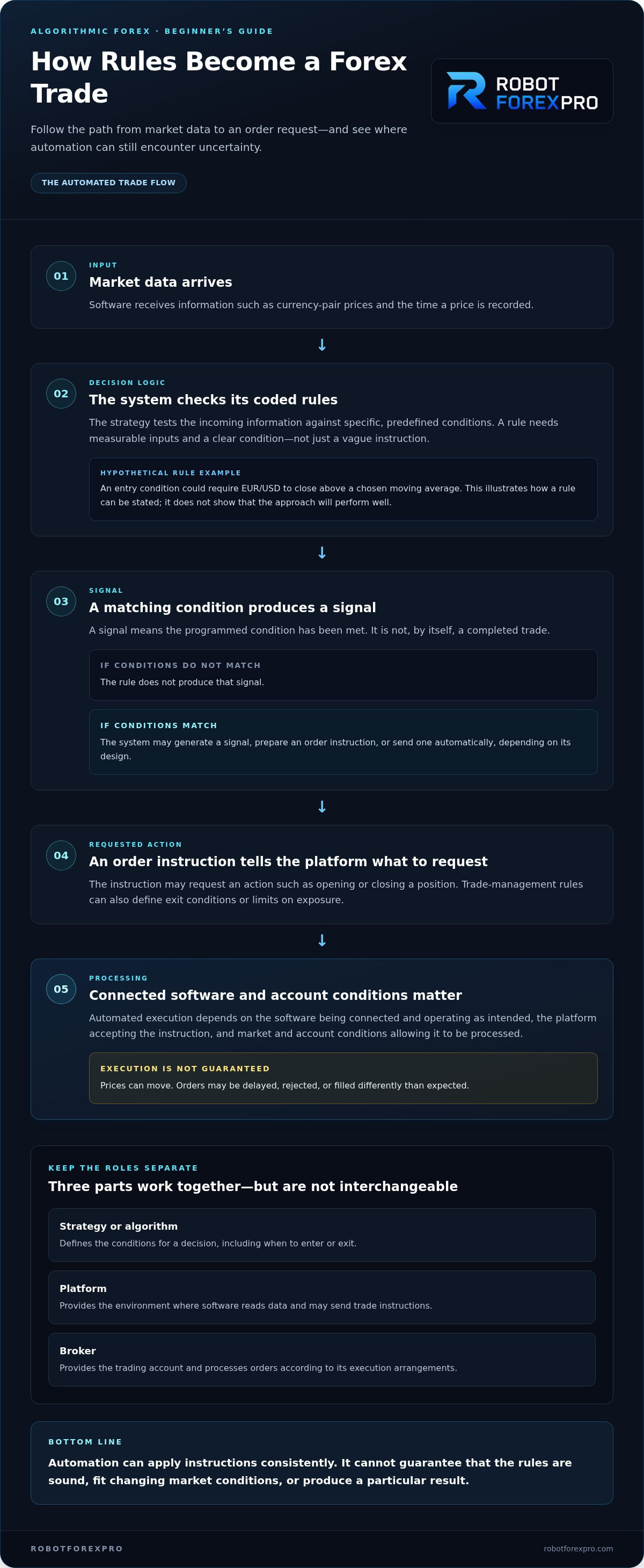
Keep three components separate. The strategy or algorithm defines the conditions for a decision. The platform provides the environment where software reads data and may send trade instructions. The broker provides the trading account and processes orders according to its execution arrangements. They work together, but they are not interchangeable. A strategy can be described without an EA, and an EA is not a broker.
How an automated forex trade moves from rule to order
First, software receives market data, such as prices for a currency pair. It checks that information against predefined conditions. For example, a hypothetical strategy might look for a specified price pattern on EUR/USD and require an additional condition before producing a signal. This illustrates how rules can be structured, not what you should trade.
If the conditions match, the system may generate a signal, prepare an order instruction, or send that instruction automatically. A signal says a rule has been met. An order instruction tells the connected platform what action to request, such as opening or closing a position. This distinction helps beginners see where analysis ends and execution begins.
A signal alone doesn’t complete a trade. Automated execution depends on the software being connected and operating as intended, the platform accepting the instruction, and market and account conditions allowing it to be processed. Prices can move, and orders may be delayed, rejected, or filled differently than expected. Automation follows its configured process; it doesn’t remove these operational variables.
What beginners mean by an Expert Advisor
An Expert Advisor, often shortened to EA, is a software program used with a supported trading platform to carry out programmed trading instructions. Depending on its design, it may analyse conditions, generate signals, manage orders, or execute trades. Its specific role comes from its code and settings, not from the EA label alone.
An EA follows instructions rather than applying independent judgement. It won’t automatically understand whether an assumption has stopped fitting the market or whether a rule needs review. Treat the automation function and trading results as separate questions: software can implement a process consistently, but that consistency does not establish that the process is sound or profitable.
How Algorithmic Forex Trading Systems Turn Rules into Decisions
A strategy becomes executable only when its decisions are expressed as specific conditions. It needs rules for when to enter a market, when to exit, and what to do while a position is open. If a rule says “buy when momentum is strong,” the software still needs a measurable definition of strong momentum, the data to assess it, and a condition that ends the trade.
Every automated strategy depends on its coded assumptions and inputs, so its decisions are only as relevant as the rules and data behind them. For algorithmic forex trading for beginners, this is a core distinction: software can apply a rule precisely without proving that the rule is appropriate for current market conditions.
The core parts of a forex trading rule
A system can use inputs such as currency-pair prices, the time a price is recorded, and selected technical indicators calculated from price data. The strategy then tests these inputs against conditions. For a hypothetical example, an entry rule might require EUR/USD to close above a chosen moving average. An exit rule might close the position if price crosses back below it. These conditions clarify what the algorithm checks, but they don’t establish that the approach will perform well.
Separate the signal rule from the order instruction. A signal rule identifies a condition, such as a qualifying price close. An order instruction specifies what action the system should request after that signal, such as opening a position or closing an existing one. Trade management adds rules for handling the position, including exit conditions or a limit on how much exposure the strategy can take.
Finding a signal and deciding position size are different tasks. A strategy might identify a possible entry, while separate settings determine how large the position is and what risk limits apply. Don’t assume that a clear entry rule also defines suitable exposure. Review these components independently.
Common algorithmic strategy families
Strategy labels describe broad types of logic, not reliable results. Trend-following systems attempt to act in the direction of sustained price movement. Their rules must define how the system identifies a trend and what would invalidate that reading. Mean-reversion systems instead seek movement back toward a chosen reference, such as an average price. That logic depends on the assumption that price may return toward the reference; it may not do so within the system’s chosen timeframe.
Other labels describe different operating approaches. Scalping strategies seek to act on short-term price movements, while news-based strategies use rules tied to scheduled or emerging news. These approaches can involve distinct data, timing, and execution demands. A strategy name alone doesn’t show how its rules behave in practice.
Before comparing software, write down the system’s inputs, entry conditions, exit conditions, and trade-management rules. RobotForexPro sells prebuilt Forex Expert Advisors, which you can evaluate once you understand the logic you want an automated system to implement.
Does Forex Automation Make Trading Safer or More Profitable?
Forex automation can apply programmed rules consistently, but it can’t guarantee profitable trades or make market risk disappear. Consistency is a process benefit. It means the software can follow its instructions without hesitation or emotional intervention, not that those instructions are sound or will suit every market condition.
For algorithmic forex trading for beginners, separate what automation does operationally from what happens financially. Software may monitor specified conditions and submit an order faster than a person acting manually, but actual execution depends on the platform, connection, liquidity, and market conditions. Leverage adds another layer of risk: it can magnify losses as well as gains. Neither automated execution nor a strategy label changes that exposure.
- Operational capability: Apply coded rules consistently, monitor specified inputs, and submit instructions without requiring a manual decision for every signal.
- Operational limitation: Software can encounter errors, connection problems, or execution differences. Automation still requires oversight.
- Financial possibility: A strategy may produce gains under some conditions, but results vary and are never assured by automation.
- Financial risk: Poor assumptions, changing markets, and leveraged exposure can contribute to losses. Consistent execution does not prevent them.
What automation can improve, and what it cannot
Rules can reduce decisions made in response to fear, impatience, or excitement. A system may follow an entry condition even when a trader feels uncertain, and it may apply a predefined exit rather than wait in hope. That can make the process more systematic. It doesn’t establish that the entry or exit rules are appropriate.
Speed is also conditional. Software may process and send an instruction quickly, but the order still has to pass through the connected platform and be handled under current market conditions. A sudden price move, technical fault, or flawed setting can affect what happens. Algorithms don’t remove the need to understand the strategy, monitor its operation, and account for market uncertainty.
Why backtests and past performance need context
A backtest applies strategy rules to historical data. Its results describe how those rules would have behaved under the selected data, settings, and assumptions. They don’t show what will happen next. If the historical data omits relevant trading costs or uses assumptions that differ from real execution, the results may not represent live conditions accurately.
Overfitting is another limitation. A strategy can be adjusted to match past price patterns so closely that it performs less reliably on new data. Markets also change: conditions that supported a rule in one period may not persist. Treat past performance as evidence to examine, not proof of future outcomes. Review the assumptions behind a result before drawing conclusions, and keep monitoring any system used in live conditions.
How Beginners Can Learn Algorithmic Forex Trading Step by Step
Build knowledge in sequence. Learn how currency markets work before comparing automated systems. A clear learning path helps you assess what a system is designed to do, what evidence supports its rules, and how it behaves in practice. The aim is informed evaluation, not a shortcut to live trading.
- Learn the market basics. Understand currency-pair notation, such as EUR/USD, and how bid and ask prices form a spread. Learn what leverage means and how it can increase exposure to market movements. These concepts help you interpret an algorithm’s decisions and the conditions under which orders are placed.
- Choose a strategy idea and define its scope. Specify the intended currency pair or market, timeframe, and conditions the system will monitor. For example, decide whether your idea concerns price movement on a short or longer timeframe. This scope gives the rules a defined context before you compare software.
- Write the rules in testable terms. State what would trigger an entry, what would close or manage a position, and what would invalidate the original idea. Avoid vague instructions such as “enter when the market looks strong.” Replace them with observable conditions that can be applied consistently. Consider risk limits separately from the signal itself.
- Evaluate the evidence and its limits. Review how the rules behave across different market conditions, and examine the assumptions behind any historical results. To interpret performance measures more deeply, use a dedicated guide to evaluating forex robot performance metrics. Metrics are most useful when you understand what data and conditions produced them.
- Practice cautiously in a demo environment. Use demo trading to learn how the software and platform behave, how signals appear, and how orders are handled. Demo activity can reveal operational issues, but it doesn’t prove that the system will produce the same results with live trading or under different execution conditions.
Build a foundation before choosing automation
Keep a written record of the strategy’s intended market, timeframe, inputs, and decision rules. Include the conditions that would make you stop treating the idea as valid. This prevents a comparison from becoming a search for software based only on attractive claims or potential gains. In algorithmic forex trading for beginners, a clearly defined process makes evaluation more disciplined.
Move from observation to controlled practice
Observe how the system responds to different market conditions before drawing conclusions. Focus on whether it follows its stated rules and whether you can explain its behavior. Keep platform installation and detailed backtesting procedures in their dedicated guides; here, the priority is understanding the system’s intended operation and the limits of demo evidence.
Once you can describe the rules and evaluation criteria, review RobotForexPro Forex Expert Advisors as one software route for implementing predefined instructions.
Where Expert Advisors Fit in a Beginner's Forex Trading Plan
An Expert Advisor (EA) is software that can implement programmed trading instructions through a trading platform. It’s one option in a broader workflow, not a substitute for understanding the strategy. An EA is not a broker or managed account. The trader remains responsible for understanding the rules, risk exposure, and operating assumptions behind the software.
For algorithmic forex trading for beginners, compare the available approaches by how they work and what you need to learn:
- Manual rule execution: You identify conditions and place or manage orders yourself. This keeps each decision visible, but requires attention and consistent application of the rules.
- A self-built algorithm: You translate a strategy into code and maintain it as needed. This gives you direct control over implementation, but demands programming knowledge as well as trading and testing skills.
- An off-the-shelf EA: You use existing trading software to implement its programmed instructions. This can reduce the need to build the system’s code, but you still need to understand what the software is intended to do and evaluate its assumptions and risks.
None of these methods removes responsibility. Manual execution can be inconsistent; self-built code can contain errors; and ready-made software still requires informed evaluation. Automation changes how instructions are carried out. It doesn’t establish that a strategy is appropriate or assure a particular result.
Self-built algorithm or ready-made Expert Advisor?
Building a system means defining its logic, translating that logic into code, and maintaining the implementation. Using an existing EA shifts the coding work, but not the need to understand the trading logic. Before using either route, be able to describe the intended market, timeframe, rules, risk assumptions, and conditions that could make the approach unsuitable. A ready-made tool isn’t a reason to skip that work.
Choose based on your learning goals and capacity. If your immediate goal is to understand trading rules, begin by documenting and observing a simple strategy rather than adding coding or software complexity. If you’re considering an EA, evaluate its purpose and available evidence as carefully as you would a system you built yourself.
Explore software after defining your requirements
RobotForexPro sells off-the-shelf Forex Expert Advisors, including RFP GoldenStar EA, RFP MultiPair EA, and RFP AlphaHype EA. Their names alone don’t establish how they operate or what results they may produce. First define your requirements, then use a structured evaluation process. A separate guide to buying Forex EA software can support that review; focus on understanding the system rather than treating automation as an outcome.
For a closer look at software options for implementing predefined trading rules, visit RobotForexPro Forex Expert Advisors.
Make Your Next Step a Clear Evaluation
Before choosing an automated system, create a short evaluation brief. Record the market you want to observe, the rules you expect the software to follow, and the evidence you’ll need to understand its operation. Use that brief to keep your next steps focused, whether you continue learning, practise in a demo environment, or compare Expert Advisors.
RobotForexPro develops and sells proprietary Forex Expert Advisor software, with currency-focused and gold-focused systems in its portfolio. Treat each EA as a software option to evaluate against your defined requirements, not as a substitute for your own trading decisions.
Algorithmic forex trading for beginners has a practical starting point: define what you need before selecting the tool. Explore RobotForexPro Expert Advisors and consider how an EA fits the process you’ve built. Keep learning, stay deliberate, and move forward with clear criteria.
Frequently Asked Questions
What is algorithmic forex trading?
Algorithmic forex trading uses software to apply predefined rules to forex-market data and, depending on the system, generate signals or send trade instructions. The strategy defines the decision logic; the trading platform provides the environment through which software may communicate with a trading account. For example, a rule might flag a price condition without placing an order. Automation changes how rules are applied; it can’t predict every market move or ensure a profit.
Can beginners do algorithmic forex trading without coding?
Yes. Coding is needed to build many custom systems, but some retail traders use existing Expert Advisor software instead. That avoids writing the EA’s code, not the work of understanding how it operates. Before using one, learn what conditions it responds to, what actions it can take, and what risks apply. Software ownership doesn’t establish that a strategy suits your situation or that its results will meet expectations.
Is algorithmic forex trading profitable?
It can be profitable, but profitability depends on the strategy, trading costs, execution, market conditions, and risk controls. Automation alone doesn’t create an edge or guarantee returns. Historical tests and past performance show how a system behaved under particular conditions, not what it will earn in the future. Treat strong performance claims critically. Before using real funds, consider whether you understand how losses could occur and how much exposure you can tolerate.
Do forex trading algorithms work all the time?
No. An algorithm can operate only when its required platform, data, and execution environment are available. A market closure, lost connection, platform setting, or technical fault can interrupt or alter its operation. For example, a system may miss a signal if its data feed stops updating. Users remain responsible for understanding their setup and monitoring whether it’s functioning as intended. Don’t assume that automation means continuous operation or uninterrupted order execution.
Is algorithmic forex trading suitable for beginners?
Beginners can study algorithmic forex trading, but deciding whether to use it depends on their grasp of forex, leverage, software, and possible losses. Learn basic market concepts first, then practise explaining a strategy’s rules and risks before considering live trading. A demo account can help you observe how software behaves, including how it responds to signals. Demo results don’t prove that the system will perform similarly with real funds.
What is the difference between an Expert Advisor and a forex trading algorithm?
A forex trading algorithm is the coded logic or set of rules used to make trading decisions. An Expert Advisor is software used with a trading platform to implement programmed instructions. The terms aren’t interchangeable: algorithms can be implemented in different ways, and EAs can vary in purpose and design. For instance, one EA may provide signals while another may handle order instructions, depending on how each is built.
Can a forex algorithm guarantee a profit?
No. Forex prices, execution conditions, and trading costs can change, and losses are possible. An algorithm applies instructions; it doesn’t remove uncertainty from the market or ensure that its rules will remain effective. Reject claims of guaranteed returns, and don’t treat any trading software, including RobotForexPro’s Expert Advisors, as a guaranteed investment. Before using an algorithm, understand its purpose, risks, and the possibility that you could lose money.