

The faster option isn’t automatically the better fit. In forex ea vs manual trading, an EA can apply programmed rules consistently, but you remain responsible for monitoring risk and responding when market conditions shift. Manual trading gives you direct control over each decision, yet demands time, attention, and discipline when the market moves quickly.
If you’re weighing the two, the real question isn’t whether automation or human judgment is superior. It’s which workflow matches your available time, decision-making style, and tolerance for ongoing oversight. Both approaches carry risk, and neither guarantees results.
This guide compares how manual and EA-based trading handle execution, flexibility, consistency, and risk. You’ll see what an EA automates, where human oversight still matters, and how changing conditions can affect a rules-based system. It also explains what to evaluate before relying on automation, so you can choose a practical approach rather than treating software as a hands-off solution.
Key Takeaways
- In forex ea vs manual trading, the main difference is who applies the rules: you or software configured to follow them.
- Map each approach’s workflow, from spotting a trade opportunity to placing orders and monitoring the account.
- Compare control, time demands, flexibility, and execution consistency without treating any of them as proof of better returns.
- Choose based on the attention you can give trading, your comfort with fixed rules, and how often you want to intervene.
- A hybrid setup can divide tasks between an EA and human oversight, but it doesn’t automatically reduce risk or improve results.
Forex EA vs manual trading: what actually changes?
Manual Forex trading means a person interprets market information and decides whether to place, manage, or close a trade. Forex EA trading uses software to carry out configured trading rules within a supported trading platform. The key difference is where trade decisions are applied: by the trader in real time, or by a system responding to conditions specified in advance.
That distinction changes the workflow, not the underlying quality of a strategy. An EA can apply rules consistently, but it can’t make those rules profitable by itself. The trader remains responsible for choosing an approach, setting it up appropriately, and supervising its operation and risk.
What does manual Forex trading involve?
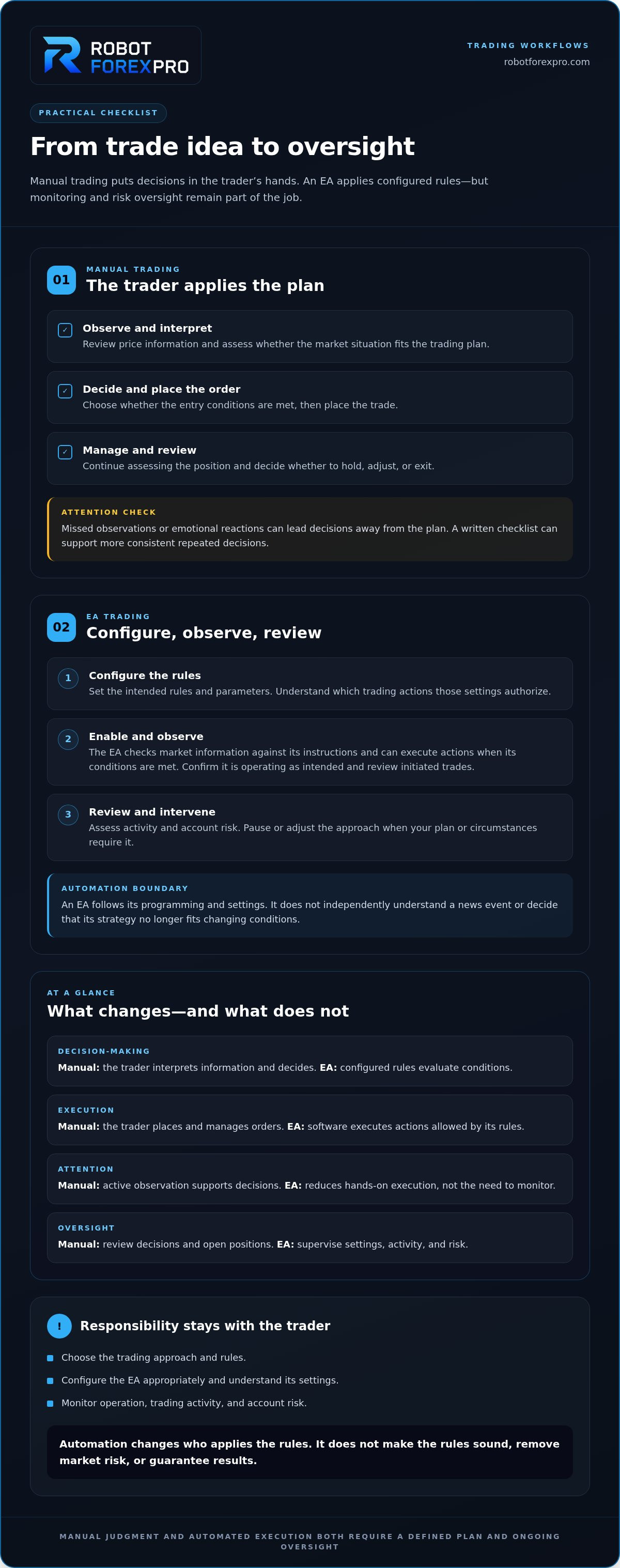
A manual trader reviews price information, interprets the situation, then decides whether an entry fits their plan. They place the order and continue assessing whether to hold, adjust, or exit. Discretion can help a trader account for context that is difficult to translate into fixed instructions, but decisions still depend on attention, discipline, and a repeatable process. Missed observations or inconsistent execution can cause trades to depart from the plan.
What does an Expert Advisor automate?
An Expert Advisor, or EA, is software that evaluates market conditions against configured rules and can execute the resulting trading actions within a supported platform. The rules may define when to enter or exit, but the EA only works according to its programming and settings. It doesn’t independently understand whether its strategy remains suitable as conditions change.
EA trading is a form of algorithmic trading: decisions and actions follow a defined process. That doesn’t mean every EA uses artificial intelligence. Rule-based automation follows specified instructions; machine-learning systems are designed to identify patterns from data and may adapt their behavior. The terms aren’t interchangeable, and automation alone doesn’t mean an EA can adapt.
Execution can be automated, but exposure to market movements remains. Traders still need to choose the rules, configure the EA, and monitor its activity and account risk. If a setup behaves unexpectedly or conditions shift, oversight matters. Automation changes who or what applies the rules; it doesn’t transfer responsibility for the trading approach.
The practical contrast is clearest across four areas:
| Area | Manual trading | EA trading |
|---|---|---|
| Decision-making | Trader interprets information and decides. | Configured rules evaluate conditions. |
| Execution | Trader places and manages orders. | Software executes actions allowed by its rules. |
| Attention | Requires active observation for decisions. | Reduces hands-on execution, not the need to monitor. |
| Oversight | Trader reviews decisions and open positions. | Trader supervises settings, activity, and risk. |
So, forex ea vs manual trading isn’t a choice between human skill and guaranteed automation. It’s a choice about how trading rules are applied and how much direct involvement you want in each decision.
How manual decisions and Forex EA execution work in practice
The difference becomes practical when a trading idea turns into an order. A manual trader observes the market, judges whether a setup meets their plan, places the trade, then decides how to manage or close it. With an EA, the trader configures rules first; the software checks for those conditions and can execute the actions they permit.
An EA automates execution rules, not market certainty.
In both workflows, the underlying strategy sets the logic. A manual trader can apply a weak or inconsistent plan; an EA can apply flawed rules with precision. Automation changes who acts on a signal, not whether the signal is sound.
The manual trading decision cycle
A trader might watch for a planned price level, then assess whether current price action matches the entry conditions. If it does, they choose whether to enter and place the order. After entry, they monitor the position and decide whether the original exit conditions still apply. Discretion can account for context that is hard to express as fixed rules, but it isn’t automatically more adaptive or reliable.
Attention shapes each step. A distracted trader may miss a setup or delay an exit; emotional reactions can also lead to decisions that depart from the plan. A written checklist can help make repeated decisions more consistent while preserving the trader’s ability to assess context.
The EA execution and oversight cycle
EA use starts before a signal appears. The trader selects the strategy, configures its rules and relevant settings, then enables the software on its supported platform. The EA evaluates incoming market information against those instructions. If its conditions are met, it can execute the defined action; it doesn’t independently understand a news event or decide that its strategy no longer fits the market.
Execution is only one part of the workflow. The trader still needs to observe activity, review orders and account exposure, and decide when intervention is appropriate. Treat this as an operating cycle, not a one-time setup:
- Configure: Set the intended rules and parameters, then understand what actions they authorize.
- Enable and observe: Confirm the EA is operating as intended and review the trades it initiates.
- Review and intervene: Assess activity and risk; pause or adjust the approach when your plan or circumstances require it.
These checks define the boundary between automation and human responsibility. The software can follow instructions, but the trader decides which instructions to use and remains accountable for oversight. If a market event falls outside the EA’s programmed conditions, the software may not respond as a person would. Manual traders face their own constraints: they can interpret new information, but must make and carry out those judgments themselves.
That’s the operational core of forex ea vs manual trading. If you’re considering software for rule-based execution, explore RobotForexPro Forex EA software to learn about the EA approach. The fit still depends on the strategy, setup, and oversight you’re prepared to maintain.
Manual trading vs Forex EA: compare control, time, and consistency
The practical differences between manual trading and an EA come down to how decisions are applied and what kind of attention each workflow requires. Manual trading gives you direct control over each action. An EA applies configured rules repeatedly, but its consistency depends on those rules and their setup. These are operational differences, not evidence that either approach will produce better returns.
| Factor | Manual trading | Forex EA |
|---|---|---|
| Control | You decide whether to enter, manage, or exit. | Rules govern actions unless you intervene. |
| Execution consistency | Can vary with attention, judgment, and discipline. | Applies configured conditions repeatedly, subject to setup and operating conditions. |
| Time demands | Requires time to observe markets and make decisions. | Can reduce hands-on execution, but still requires supervision. |
| Flexibility | You can reassess context and change a decision in real time. | Responds within its programmed conditions. |
| Monitoring | You track decisions and open positions directly. | You review activity, settings, and account exposure. |
Where manual trading offers more discretion
Manual trading lets you pause before placing an order, reassess a setup, or decide that new context changes your plan. That flexibility can help when a situation doesn’t fit a predefined checklist. It also places the burden on you to stay attentive and apply your process consistently. Fatigue, distraction, or emotional pressure can affect decisions, and human judgment can’t reliably anticipate unexpected market moves.
Where an EA offers more execution consistency
An EA can apply its configured conditions without fatigue or hesitation. That can make execution more repeatable, provided the rules and settings are appropriate and the software operates as intended. But fixed rules have limits: the EA responds to what it is programmed to evaluate, not every possible change in market context. Less time spent placing trades doesn’t mean monitoring can stop. You remain responsible for reviewing activity and deciding whether to intervene.
Use the comparison to assess fit, not predict performance. If you want to make each trade decision yourself and can give it sustained attention, manual execution may align with your workflow. If you prefer rules to trigger actions consistently and can supervise the system, an EA may suit your operating style. Neither choice removes the need to understand the strategy or manage risk.
Before choosing, consider which trade-offs you can manage day to day:
- Choose for direct discretion if you want to make real-time decisions and can follow a defined process under pressure.
- Choose for rule-based execution if you value repeatability and will still review settings, activity, and risk.
- Reassess your capacity if either approach demands more attention or oversight than you can reliably provide.
The right choice in forex ea vs manual trading depends on your workflow, strategy, and capacity for oversight, not on an assumption of better returns.
How to decide between an EA and manual Forex trading
Choose an approach by starting with your actual trading process, not a software feature list or the appeal of hands-on control. Define what you trade, how you identify a setup, what decisions need to be made, and how much time you can reliably devote to execution and review. Then match the workflow to your attention, comfort with fixed rules, and desired level of intervention.
- Available attention: Can you regularly observe the market and make decisions, or do you need software to apply defined rules?
- Rule preference: Do you want discretion at each decision point, or are you comfortable setting conditions in advance?
- Intervention: How often do you want to review activity or step in when circumstances change?
- Risk process: Can you define how you’ll manage exposure and respond when a trade moves against your expectations?
These questions help clarify fit, but they don’t predict performance. Before using an EA in live trading, evaluate its operation in a controlled setting. Check whether its actions match the rules you intended, observe how it responds to different conditions, and decide how you would handle unexpected behavior. Don’t assume a short test or favorable result establishes future outcomes.
Choose manual trading when direct decision-making is central
Manual trading may fit if you want to interpret market information yourself, decide whether a setup is still valid, and retain direct control over entries and exits. Be realistic about your schedule: the method depends on giving decisions consistent attention, not just preferring control in theory. Set risk controls before trading. Personal involvement doesn’t prevent rushed decisions or remove exposure to loss.
Choose EA trading when rule-based execution fits your process
An EA may suit a process built around defined conditions that you want software to apply repeatedly. Consider whether you’re ready to understand its configuration, review its activity, and intervene when needed. If the EA can act across multiple currency pairs, account for that broader portfolio scope in your evaluation. A multi-pair Forex EA evaluation guide can help frame those considerations.
When selecting software, compare its strategy logic, operating requirements, and the oversight your workflow will demand. Evaluate the approach before committing capital, and keep responsibility for risk decisions in your hands.
If rule-based execution fits your process, explore RobotForexPro Forex EA software as a next step in assessing an EA-based workflow.
Can a hybrid approach combine manual oversight with Forex EA execution?
Yes. A hybrid approach can assign a defined part of the trading process to an EA while keeping the trader responsible for monitoring and intervention. For example, software can apply configured entry and exit rules, while the trader reviews account activity and decides whether operating conditions still match the plan. This creates a division of tasks, not a transfer of responsibility.
Combining manual oversight with automated execution doesn’t automatically reduce risk or improve results. The EA still follows its rules, and human oversight is only useful when it has a clear purpose. Unplanned overrides can undermine the consistency the system was meant to provide. Set boundaries before trading: define what the EA handles, what you monitor, and which conditions justify stepping in.
Set clear boundaries between automation and human decisions
Start by documenting the trading rules and your oversight process. Specify what activity you’ll review, when you’ll review it, and what would prompt you to pause the system or reassess the approach. The goal isn’t to predict every market event. It’s to make responsibility and response decisions explicit.
Frequent discretionary changes can create a second, inconsistent strategy layered over the EA. If you override a rule whenever a trade feels uncomfortable, the system no longer represents the process you intended to evaluate. Record the reason for each intervention and review those decisions against your plan. That record can help distinguish a deliberate exception from an impulsive reaction.
- Define the software’s role: Identify which decisions the EA is authorized to execute.
- Set monitoring expectations: Decide how you’ll review trading activity and account exposure.
- Document intervention rules: State when you may pause, adjust, or stop the process, and why.
- Review the evidence: Compare actual activity with the intended rules before changing the setup.
Explore EA software without treating automation as a promise
RobotForexPro develops and sells proprietary Expert Advisor software for independent retail traders. Its portfolio includes RFP GoldenStar EA, RFP MultiPair EA, RFP Gold V5.7 EA, RFP AlphaHype EA, RFP JapanStrike EA, RFP EuroStable EA, and RFP SmartProfit EA. These products are software options to assess against your own strategy and requirements, not evidence of a particular trading result or a guarantee of suitability. Consider your risk controls and capacity to supervise any EA you use.
RobotForexPro sells software, not brokerage, PAMM, or managed-account services. The trader retains responsibility for evaluating and using the software. In forex ea vs manual trading, a hybrid workflow may fit if you want software to apply defined rules and are prepared to maintain human oversight. It still involves market risk, and the combination itself offers no assurance of improved performance.
If you’re considering that workflow, explore RobotForexPro's EA software and evaluate whether an EA aligns with your trading process and oversight capacity.
Build a trading process you can sustain
Make your next step practical: write down how you’ll make decisions, what you’ll monitor, and what would prompt you to pause or revise your approach. Use that operating plan to judge whether manual execution, an EA, or a defined combination fits your actual routine. A clear process gives you a basis for evaluation without assuming that either method can control market outcomes.
RobotForexPro develops proprietary Expert Advisor software for independent retail traders, with products focused on currency and gold trading. Assess an EA against your own requirements, risk controls, and capacity for oversight. Choose deliberately, then keep responsibility for your decisions and account activity firmly in view.
The right answer to forex ea vs manual trading is the approach you can operate with discipline and review consistently. Take the next step: explore RobotForexPro's Expert Advisor software and consider how it fits your process. A well-defined workflow is a stronger starting point than automation alone.
Frequently Asked Questions
Is Forex EA trading better than manual trading?
No approach is inherently better for every trader or strategy. In forex ea vs manual trading, compare how each fits your routine and how you’ll evaluate decisions. For example, if you can reliably follow a written plan but have limited time to place trades, automation may suit your workflow. If you want to assess each setup yourself, manual execution may be a better fit. Neither choice establishes likely returns.
Can a Forex EA trade without supervision?
An EA may execute trades automatically, but it shouldn’t be treated as a system that needs no supervision. Set a routine to review its activity, confirm it’s behaving as intended, and check that its rules still fit your plan. For example, if orders differ from what you expected, investigate before allowing the same setup to continue. You remain responsible for deciding whether to pause or change your approach.
Do Forex EAs remove emotions from trading?
An EA can reduce emotional choices during execution because it follows its configured rules instead of reacting to fear or excitement. But it doesn’t remove emotion from the trader’s decisions. You still choose the system, set its parameters, and decide whether to intervene. For example, changing settings after a losing trade because you want a quick recovery can introduce emotion back into an automated process.
Can beginners use a Forex Expert Advisor?
Beginners can use an EA, but should first understand the trading plan it follows and the risks involved. Learn what its settings control, what conditions may trigger trades, and how you would respond to unexpected activity. Evaluate the process without assuming that a simple interface makes the strategy simple or safe. Never use software as a substitute for learning basic risk management.
Do Forex EAs work in every market condition?
No. An EA responds to the conditions and rules it was designed to evaluate, so its behavior may not suit every market environment. A system built around particular price behavior, for instance, may respond differently when volatility changes or price moves sharply. Review how the EA is intended to operate and assess its behavior under varied conditions. Past performance or successful testing can’t guarantee future results.
Can I combine manual Forex trading with an EA?
Yes. You could use an EA for a defined set of trades while making other trading decisions manually, or monitor software execution and intervene according to a written rule. Keep the boundaries clear. If you manually change or close EA-managed trades without recording why, it becomes harder to assess whether the software followed its rules or whether your intervention changed the outcome. Combining methods doesn’t remove trading risk.
Does using a Forex EA guarantee profits?
No. An EA is trading software, not a guarantee of profit. Results depend on the strategy, settings, market conditions, and execution, and losses are possible. Before relying on an EA, identify how it makes decisions, what risks its trading approach may carry, and how you’ll monitor it. Avoid judging a system by a single favorable result; assess evidence carefully and only commit funds you can afford to lose.