

Copy trading can feel more hands-off, but it does not remove the need to understand risk. The forex robot vs copy trading decision comes down to who supplies the trade logic: a robot executes programmed rules, while copy trading mirrors a selected trader’s or provider’s trades. Choose a robot if you prefer rule-based execution; choose copy trading if you want to follow another trader’s decisions.
Both approaches automate parts of trading, but they offer different kinds of control. A robot follows its configured strategy, so you need to understand its rules and risk settings. With copy trading, results depend on the provider’s decisions, including losses as well as gains. Past performance does not guarantee future results.
This guide explains what forex robots and Expert Advisors are, how copy trading works, and how the methods differ in execution, oversight, and risk. It also provides a practical comparison to help you choose based on your trading preferences.
Key Takeaways
- Choose rule-based automation when you want software to execute a defined strategy; copy trading follows another trader’s decisions and exposes you to their losses as well as gains.
- Compare more than win rates. Understand the strategy, money management, and potential drawdowns before choosing an approach.
- Keep control when copying trades by setting allocation and risk limits that fit your own plan.
- Test automated strategies in a demo environment and assess how they behave beyond backtests before using real money.
- Match the method to your preferred level of involvement, technical comfort, and ability to monitor risk.
Forex Trading Robot Guide: Do Bots Really Work in 2026?
Forex robots execute preset rules; copy trading mirrors a selected trader’s orders. Your technical skills, risk tolerance, and preferred level of involvement can help determine which approach suits you.
Regulation and Costs
In the United States, applicable rules depend on the product and provider. In practice, trading software, an order-copying platform, and a provider making trading decisions can have different roles. Costs also depend on the setup. Robot expenses may include software, platform access, or hosting; copy trading may involve platform charges, performance fees, or trading costs. Review each fee structure before comparing options.
Profit Expectations
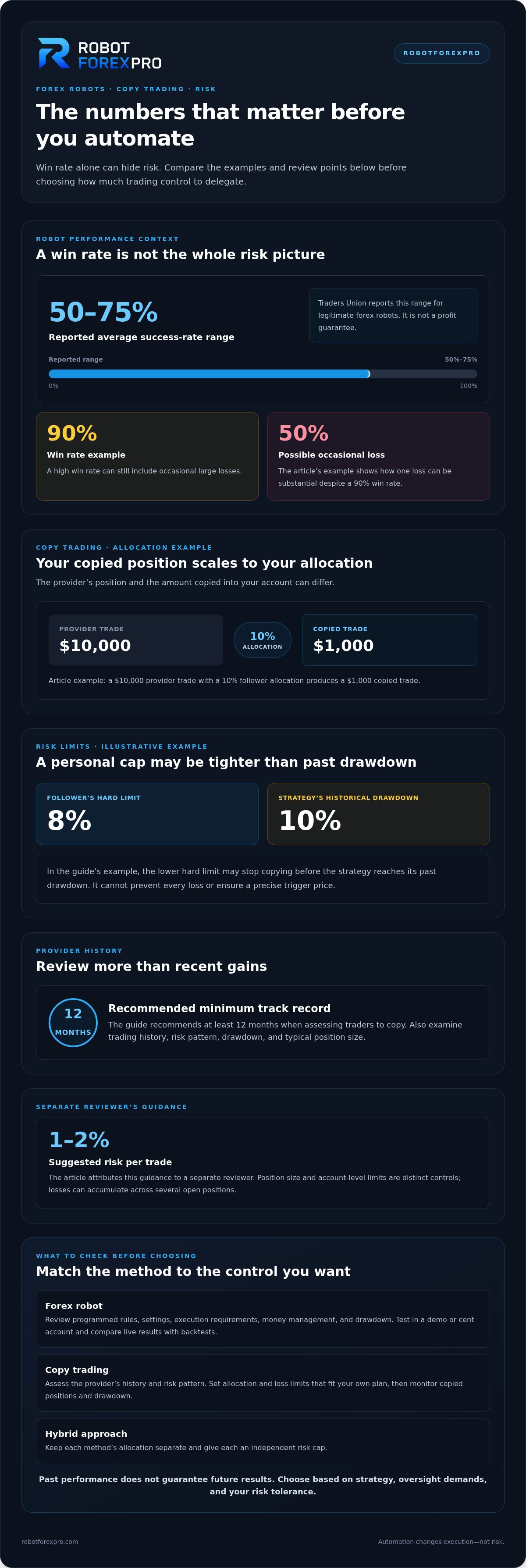
Neither a robot nor copy trading can guarantee profits. A robot can keep following programmed rules after market conditions change, while a copied trader can make losing trades. Traders Union reports legitimate forex robots have average success rates ranging from 50 to 75%. Win rate alone doesn’t show risk: a robot with a 90 percent win rate could still have occasional losses of 50 percent.
Choose based on the work you want to do. If you are comfortable reviewing strategy logic, you may prefer a robot with settings you understand. If you want to follow another person’s decisions, copy trading may suit you, provided you set allocation limits. For example, someone unable to explain a robot’s entry and exit rules has less direct control than someone who can review them.
- Robot: Review its rules, settings, and execution requirements.
- Copy trading: Select a provider, then set allocation and risk limits.
- Hybrid: Separate each method’s allocation and risk cap.
Test a robot before using real money. Start with a demo or cent account, then compare live results with backtests. Review its money management, drawdown, and handling of broker-server errors or connection problems. A strong backtest alone does not show how a program behaves in live execution. A virtual private server can help reduce interruptions caused by power or internet outages.
When choosing traders to copy, examine their trading history and risk pattern, not just recent gains. The guide recommends a track record of at least 12 months. Compare drawdown with your tolerance, and check whether the provider’s strategy matches your own limits. For instance, a follower seeking lower volatility may reject a provider whose past losses exceed their planned risk.
| Option | Control | Technical involvement | Key review |
|---|---|---|---|
| Forex robot | Strategy settings | Higher | Rules and drawdown |
| Copy trading | Allocation limits | Lower | Provider history |
| Manual trading | Trade decisions | Higher | Personal discipline |
| Hybrid approach | Separate controls | Variable | Independent risk caps |
Choose the approach whose strategy, oversight demands, and drawdown profile fit your skills and risk tolerance.
What is copy trading?
Copy trading connects your account to a selected trader’s activity. Trades can be copied automatically, while you retain control over capital allocation and risk settings.
Automatic Trade Copying
After you select a provider, the platform can mirror that trader’s orders in your account. The copied position is scaled to your chosen allocation, so your trade size can differ from the provider’s. For example, a $10,000 provider trade with a 10% follower allocation produces a $1,000 copied trade under the guide’s example.
Automation handles order copying, not your overall plan. You can choose how much capital to allocate, adjust that amount, or stop copying. These controls can help align copied activity with your risk tolerance, but they do not change the provider’s strategy or prevent a losing trade.
Trading Decision Control
The selected trader makes the entry and exit decisions; you decide whether to follow and how much capital to commit. That differs from manual trading, where you choose each trade, and from a forex robot, which follows programmed rules. Copying reduces the need to choose each entry, but you remain responsible for managing your account.
Before following a provider, compare their strategy with your own limits. Review their history, drawdown, and typical position size. Set an allocation that leaves room for losses, then monitor whether copied trades still fit your plan. Previous gains do not determine the outcome of the next trade.
Risk limits can make copying more controlled. Consider the guide’s example: a follower sets an 8% hard limit on a strategy with a historical drawdown of 10%. That limit may stop copying before the strategy reaches its past drawdown, but it cannot prevent every loss or ensure the limit triggers at a precise market price.
- Set an allocation that matches your available capital.
- Define a loss limit before activating copying.
- Review open positions and provider drawdown regularly.
- Pause or stop copying if the strategy no longer fits your tolerance.
A separate reviewer advised risking no more than 1-2% on any trade. Treat position size and account-level limits as distinct controls: a small copied trade can still contribute to cumulative losses across several open positions.
Copy trading may suit someone who wants another trader to select trades while retaining control over participation and allocation. It is less suitable if you want to approve every entry before execution. Decide how much decision-making you are willing to delegate, then apply your own risk limits.
Copy trading compared with algorithmic trading
Copy trading follows decisions made by another trader. Algorithmic trading follows rules encoded in software. A forex robot is one form of algorithmic trading, while copy trading can mirror human decisions or automated signals. The distinction affects control, execution, and what you need to review.
With a robot, the strategy determines when orders open, change, or close. Trading bots can react quickly and execute programmed strategies around the clock. That describes the software’s response, not necessarily the broker’s fill. Server delays, spreads, and price movements can still affect execution and cause slippage.
Copy trading adds a signal path. A provider places or generates a trade, a platform sends the instruction, and your account attempts execution. If the market moves during transmission, your fill may differ from the provider’s. For example, a rapid price change between the provider’s entry and your copied order can shift your entry price and affect the eventual profit or loss.
| Criterion | Copy trading | Algorithmic trading |
|---|---|---|
| Trade logic | Provider’s decisions | Programmed rules |
| Execution path | Provider, platform, follower account | Software, broker, account |
| Primary review | Provider record and risk pattern | Strategy rules and test results |
| Control point | Allocation and copying settings | Parameters and operating conditions |
Neither method removes execution risk. A robot may send orders promptly but still encounter broker-server errors or connection problems. Copy trading can add a delay between the provider’s action and your fill. In either setup, compare order timing, entry price, and account balance changes with the strategy’s intended behavior.
Use a structured comparison before choosing:
- Map the decision chain. Identify who creates the signal and which system sends the order.
- Review the record. Compare live execution with stated strategy behavior, including drawdown.
- Test the path. Use a demo account to observe order handling and price differences.
- Set limits. Define position size and risk caps separately for each approach.
The forex robot vs copy trading decision is not simply automation versus manual trading. It is a choice between delegating decisions to a provider and delegating execution to software rules. A hybrid setup might use a bot for a mechanical strategy and copy trading for discretionary decisions that depend on context. Keep each allocation and risk limit separate, then assess performance using the method’s actual execution record.
How copy trading and trading bots work
Both systems send orders into live markets, but their signal paths differ. A bot applies programmed rules; copy trading relays another trader’s activity to your account. Latency and slippage can affect either route, especially when prices move between a signal and its execution.
A forex bot monitors market data, checks conditions against its strategy, and sends an order through a connected trading platform. Trading bots can run 24/7 and react in milliseconds while executing programmed strategies. The forex market operates 24 hours a day, five days a week, so a bot can act during sessions when its owner isn’t watching. Its actual operation still depends on the configured system and its connection to the broker.
Copy trading follows a different sequence. A provider opens, changes, or closes a position; the copying platform transmits the signal; then your account attempts to place a corresponding order. The platform may scale position size to your allocation, but the copied order still has to reach your broker. If prices move during transmission, your execution price may differ from the provider’s.
Slippage is the difference between the requested price and the final fill. A fast market move can cause positive or negative slippage, while latency is a delay in the signal or order path. For a bot, a delay can occur between a rule being triggered and the broker receiving the order. In copy trading, transmission from the provider adds another stage to assess.
Consider a provider who closes a position after a sudden price change. The platform sends the close signal, but your account receives it later. Your final price may differ, changing the realized gain or loss. A robot can encounter a similar issue if its close rule triggers during a rapid move. Neither method can guarantee a fill at the requested price.
Use a demo account to observe the full order path before committing capital. Compare the signal time, order time, requested price, fill price, and account balance after each trade. Repeat the test in different market conditions, including quieter periods and rapid price movements. This can reveal whether delays or execution differences materially affect the strategy.
- For a bot: Review its order rules, platform connection, and error handling.
- For copy trading: Compare provider signals with the copied orders in your account.
- For both: Set position limits and review losses alongside gains.
- Before live use: Test the workflow and record price differences consistently.
Past performance does not guarantee future results, and a smooth test period cannot capture every market condition. Assess execution alongside results: repeated price differences can change the balance between expected risk and realized outcomes. Keep limits in place, and do not judge a system by signal timing alone.
Definition of forex trading robots and Expert Advisors
A forex trading robot is software that applies programmed rules to market data and can place or manage trades automatically. An Expert Advisor, or EA, is a trading program associated with MetaTrader platforms. The key distinction is functional: the software executes instructions, while a human trader or strategy designer supplies the logic.
Most forex robots run on MetaTrader 4 or MetaTrader 5 and require a broker that supports automated trading. MetaTrader 4 launched in 2005. An EA may monitor price conditions, check defined entry rules, and send an order when those conditions match. For example, a strategy could instruct the software to open a trade after a specified market condition occurs.
Not every EA uses the same strategy. One program may trade currency pairs; another may focus on gold or use different entry and exit rules. A robot’s behavior depends on its code and settings. If market conditions change, the software continues to follow its programmed logic unless its rules account for that change.
Think of an EA as an execution system, not an independent decision-maker. Its instructions can define when to enter or exit, how to set a position, and how to manage risk. You still need to understand those choices. For example, a strategy that opens trades frequently can behave differently from one that waits for narrower conditions.
Before using an EA with real money, follow a structured review:
- Identify the strategy. Explain its entry, exit, and position-sizing rules in plain language.
- Inspect the evidence. Compare backtests with live-account results, including drawdown and losing periods.
- Test execution. Run the program in a demo or cents account and observe orders and errors.
- Review risk controls. Confirm that the settings match your capital and tolerance for losses.
Backtest optimization alone cannot establish how an EA will behave in live markets. A robot may show a high win rate yet still experience occasional large losses, so review winning trades and losing periods. A track record also needs context: trading conditions, risk settings, and execution quality all affect how results should be interpreted.
Educational material can explain an EA’s terminology, but it cannot replace understanding the actual strategy. Do not treat a robot as a profit guarantee. The practical takeaway is simple: assess the rules, test their operation, and set risk limits you can maintain. Choose software only when you can describe what it does and how losses may develop.
RobotForexPro: RFP GoldenStar EA
RFP GoldenStar EA is an Expert Advisor for traders who prefer software to execute a defined trading approach rather than copy another trader’s decisions. It may suit readers evaluating automated forex software who are prepared to understand the strategy, settings, and risks before use.
Compare it with RFP MultiPair EA and RFP AlphaHype EA based on the trading approach you want to evaluate. Before using any EA with live capital, test it in a demo environment and review its execution, drawdown, and money management. These checks help you judge whether its operation matches your own limits.
Visit RobotForexPro to explore RFP GoldenStar EA and its automated trading software.
Set Your Next Trading Criteria
Make your next step a process decision, not a performance prediction. Define how much control you want over trade logic, what drawdown you can tolerate, and how you will assess execution before selecting a system. These criteria provide a clearer basis for choosing between automated rules and another trader’s decisions.
If you’re evaluating automated software, compare each option against the strategy and markets you intend to trade. RobotForexPro offers RFP GoldenStar EA, RFP MultiPair EA, and RFP Gold V5.7 EA. Consider the forex robot vs copy trading choice alongside your preferred level of oversight, then test your operating plan before committing capital.
Contact RobotForexPro to discuss your options and identify an EA that fits your evaluation process. Keep your criteria clear, your risk controls deliberate, and your next move informed.
Frequently Asked Questions
How do you copy trade?
Choose a provider, connect your trading account through the platform, and set the capital allocation. The platform then attempts to mirror the provider’s orders according to its copying settings. Before activating it, define your own loss limits and decide how you will respond to open positions during volatile markets. For example, set a rule for pausing copying if the provider’s strategy no longer fits your risk plan.
Do you pay profit share if the copied trader loses money?
A profit-share fee is generally tied to eligible profits under the platform’s fee rules, rather than simply to copying a trade. Under a profit-only fee model, a losing period would not create profit share to pay. Other charges may still apply independently of performance. Before allocating capital, read the platform’s fee calculation and timing rules, including how it treats earlier gains followed by losses.
What Are The Real Disadvantages and Risks of Forex Trading Robots You Need to Understand?
Robots can continue applying their rules after market behavior changes, and software cannot eliminate execution problems or drawdowns. A backtest can also overfit historical data, making a strategy appear stronger than it performs in live markets. Check the system’s broker requirements, including suitable margin, spreads, and execution, and confirm compatibility with your broker. Prop-firm rules vary, so confirm eligibility before using an EA with a prop-funded account.
What Does the Data Actually Show About Forex Trading Robot Performance?
Traders Union reports that legitimate forex robots have average success rates ranging from 50 to 75%. That figure doesn’t describe every robot or establish how much an account might gain or lose. A win rate also omits position size and loss severity. Compare a system’s full trading record, drawdowns, and risk settings. “Results verified by Myfxbook” describes verification, not a forecast of future performance.
Why Copy Trading?
Copy trading lets participants follow another trader’s decisions without choosing every entry manually. It may suit someone who wants to observe a defined strategy while retaining control over whether to follow it and how much capital to allocate. The trade-off is reliance on the provider’s judgment. For a practical evaluation, compare the provider’s approach with your goals and decide beforehand when you will stop copying.
What is the difference between a forex robot and copy trading?
A forex robot executes coded instructions; copy trading mirrors a provider’s orders. RobotForexPro sells Expert Advisor software, not copy-trading services. Its EA license is for personal use only and prohibits resale, redistribution, commercial use, copy-trading, and signal services. Each purchase licenses either 1 Live + 1 Demo account or 2 Live accounts, registered under the buyer’s name and surname. Demo and live accounts both count toward the limit.
How do forex trading robots and copy trading work?
A robot checks market data against its programmed conditions, then sends qualifying orders through its connected trading platform. Copy trading relays a provider’s trade instructions to a follower’s account. For RobotForexPro EAs, files are emailed within 24-48 hours after the required MT4 or MT5 account number is received. The EAs connect to RobotForexPro servers, and license usage may be monitored to detect unauthorized redistribution.
How do forex robots compare with copy trading in performance and risk?
Neither method guarantees a particular outcome. Compare results using the same measures, such as drawdown, position sizing, execution quality, and account-level losses. For RobotForexPro software, there are no hidden fees, upsells, or recurring charges; the digital product is non-refundable, and opting for immediate access waives any 14-day withdrawal right. Trading in Forex, CFDs, Gold, and other leveraged financial instruments carries a high level of risk and may result in the loss of your entire investment. Past performance does not guarantee future results. RobotForexPro provides software tools only and does not provide financial advice, investment services, or trading signals.