

Automation can follow a trading plan, but it cannot remove risk. Overcoming fear of automated trading losses starts with clear rules for entries, exits, and acceptable risk, and with treating losses as part of trading rather than proof that a strategy has failed. An algorithm can execute rules consistently, but it cannot guarantee profits.
It is understandable to worry when real money is at risk. Automation can reduce the pressure to react impulsively, but confidence comes from knowing how a system behaves during both winning and losing trades. This article explains how automated execution affects trading emotions, how backtesting can help assess historical performance, and why accepting losses is essential to managing risk. You will find a practical framework for evaluating a strategy, following its rules, and reviewing losses for useful information instead of letting fear drive your next decision.
Key Takeaways
- Track your decisions, emotions, and trade outcomes in a journal to spot patterns that a results-only review can miss.
- Assess a strategy through both its win rate and risk-to-reward ratio; neither metric gives a complete picture on its own.
- Set leverage and exit rules before trading to reduce the chance that greed keeps a position open longer than planned.
- Backtest at least a month of historical setups and use 100 or more trades to evaluate a strategy more fairly.
- Treat losses as part of the process, then review whether you followed your rules before changing the strategy.
1. What Emotional Triggers Does Automation Prevent?
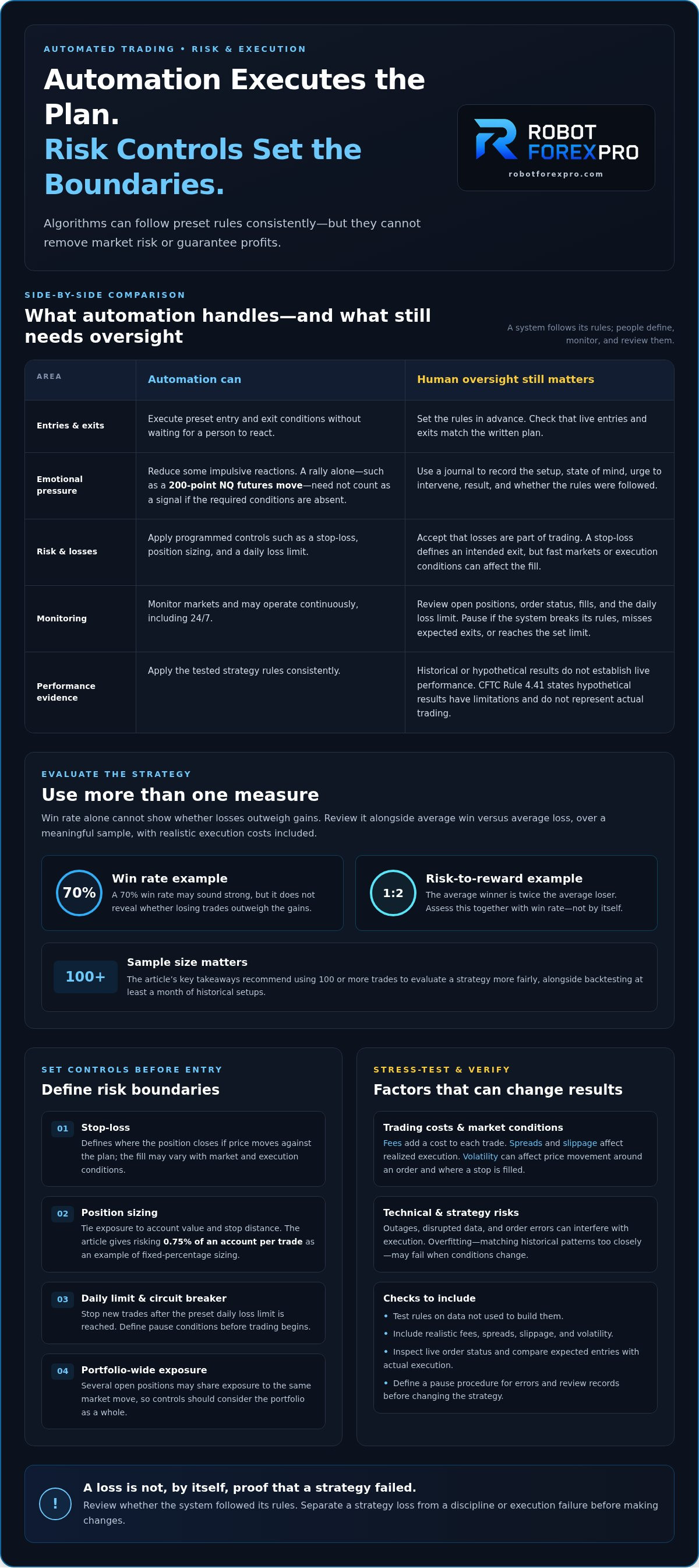
Monitor the system against its written rules, open positions, order status, and daily loss limit. Pause or shut it down if it trades outside those rules, fails to make expected exits, or reaches your set limit.
Automation reduces some emotional decisions by following preset entry and exit conditions. It can prevent a trader from chasing a price move after fear of missing out takes over. For example, a 200-point rally in NQ futures may tempt someone to enter late. A system that requires specific entry conditions won’t treat the rally alone as a valid signal. Its discipline comes from programmed rules, not confidence or fear.
Automation also monitors markets and executes trades without waiting for a person to react. Systems may operate 24/7, but continuous operation doesn’t mean every position deserves to stay open. Review order fills, open positions, and whether entries and exits match the strategy. Compare live execution with the written plan. A missed exit, unexpected order, or breached loss limit calls for action, not passive monitoring. Set the pause conditions before trading begins.
Use a journal to connect trading results with emotional triggers. Before a trade, record the setup and your state of mind. During the trade, note any urge to intervene. After it closes, record the result and whether the system followed its rules. A daily recap can reveal mistakes and areas to improve. For example, if you repeatedly override exits after a short-term price move, the journal will expose a pattern that a profit-and-loss total alone cannot show.
Review the journal alongside actual execution. Mark each trade as planned or unplanned, then note whether an emotional reaction influenced the decision. Mark Douglas says 95 percent of likely trading errors stem from attitudes about being wrong, losing money, missing out, and leaving money on the table. A 2024 study in the Journal of Behavioral Finance found retail traders cut winning trades about 30% earlier than their stated plan. These findings show why recording decisions matters.
Visualization adds a practical rehearsal step. Before a session, picture a valid signal appearing, the system entering, and the planned exit executing without manual interference. Mental rehearsal through visualization can activate neural pathways similar to those used during real performance. Pair that exercise with a written if-then plan: if the setup appears, follow its rules; if the daily loss limit is reached, pause. Review both the journal and execution records to distinguish a strategy loss from a discipline failure.
Write if-then plans before each session. Journal why you took each trade and how it played out, including your reactions, mistakes, and improvements in daily recaps.
2. Automated Trading Psychology and the Power of Algo Trading ?
Fear often comes from uncertainty about what a system will do during a losing position. Automation can execute preset entries and exits, but it cannot remove market risk or guarantee profits. In the U.S., applicable safeguards depend on the financial product and the roles of the platform and service provider. CFTC Rule 4.41 states that hypothetical performance results have limitations and do not represent actual trading.
Assess a strategy using both its win rate and its average win compared with its average loss. For example, a 70% win rate sounds strong, but it doesn’t show whether the losing trades outweigh the gains. A 1:2 risk-to-reward ratio means the average winner is twice the average loser. Review both measures across a meaningful sample, then check whether the results include realistic execution costs.
Set risk controls before enabling entries. A stop-loss defines where a position closes if price moves against the plan; it limits the intended loss, but fast markets or execution conditions can affect the fill. Fixed-percentage sizing, such as risking 0.75% of an account per trade, keeps exposure tied to account value. A daily loss limit and circuit breaker can stop new trades after the limit is reached. Portfolio-wide controls matter because several open positions may share exposure to the same market move.
Test risk under changing conditions, not just in the strategy’s preferred setup. Set position size according to the stop distance and the loss your account can absorb. Increase size gradually only after you have consistently followed the plan. Let performance records inform that decision, rather than excitement or fear of missing out.
Trading fees, spreads, slippage, and volatility can all affect realized results. Fees add a cost to each trade, while slippage means the execution price differs from the expected price. Volatility can increase price movement around an order and affect where a stop is filled. Include these factors in testing, then compare expected entries with actual execution records.
Common failures include technical outages, disrupted data, order errors, and overfitting. An overfitted strategy matches historical price patterns too closely and may fail when conditions change. Test rules on data not used to build them, inspect live order status, and define a pause procedure for errors. CFTC Rule 4.41 also cautions that hypothetical results have limitations, so historical results alone cannot establish how a system will perform in live trading.
3. How greed can lead to excessive leverage and holding positions too long
Greed can make a planned profit feel insufficient. A trader may increase leverage to amplify a winning position, then hesitate to close when momentum fades. The opposite reaction can follow a loss: holding a losing trade while waiting to recover the account. A 2024 study found retail traders held losing trades about 60% longer than planned. That gap can turn a defined exit into a larger exposure.
There’s no universal starting capital amount for automated trading. Base the decision on the loss you can tolerate and the position size your rules permit. Beginners can build execution confidence with one share, one options contract, or one micro futures contract at a time. The guiding principle is consistency: prove you can follow the strategy at a small size before expecting to trade 1,000 shares.
Reduce position size when fear causes hesitation or pushes you to interfere with a system. Smaller exposure can make it easier to follow preset exits and assess each trade on its rules. For beginners making mistakes, one practical guideline is to keep a day’s losses from exceeding $20 or $30, rather than allowing losses of $200 or $300. Treat these figures as risk-control examples, not profit targets.
Scale gradually, using execution records rather than recent profits as your guide. First establish that you can follow the strategy at your current size. Increase exposure only when your journal shows consistent rule-following across trades, including losing ones. If a larger position causes anxiety or manual overrides, reduce it again. Success means repeatable execution, not taking more risk after a winning trade.
Leverage magnifies both gains and losses by increasing market exposure relative to the capital committed. Before increasing it, calculate the planned loss based on the stop distance and position size. Consider how several open positions could respond to the same market move. If their combined exposure exceeds your limit, reduce size or avoid adding another position. A projected profit does not cancel the downside.
Use a brief review routine after each session. Record the planned and actual position size, the exit, and any urge to hold longer for extra profit. Compare the result with the strategy rather than judging a single trade in isolation. If losses cluster, check whether you followed the rules and whether the system’s expected drawdown could explain them. Do not increase leverage to recover faster. Keep size stable until your records show disciplined execution.
Once a track record of executing the trading system has been demonstrated, traders can gradually increase position size, rather than treating a single result as proof. A separate three-layer risk-management system caps system-wide drawdowns at 40%.
Mindfulness meditation may help traders manage stress and emotional reactions. Writing about performance failures can help people recognize their impact and reframe them as lessons. Traders can treat losses as information by reviewing their execution, process, and possible adjustments.
4. Using backtesting to estimate a strategy's historical performance
Backtesting applies a strategy’s rules to historical market data to estimate how they would have performed. Start with at least a month of historical setups and evaluate 100 or more trades where possible. Record each entry, exit, and result, including losing trades. A small sample can make a strategy look stronger or weaker than its broader record suggests.
Apply the same rules consistently throughout testing. If an entry requires a price breakout and a stop-loss, apply both conditions to every matching historical setup. Include realistic spreads, fees, and slippage in your assumptions because execution costs can change results. Separate the data used to develop the strategy from the data used to test it. This helps reveal whether the rules fit only the original sample.
To estimate maximum drawdown, track the strategy’s account value after each trade. Compare each peak with the lowest value that follows before a new peak. Also record consecutive losing trades. These results show the historical depth and duration of losses, helping you judge whether the strategy’s drawdowns fit your risk limits. They describe the tested period, not every possible future sequence.
Paper trading simulates trades without risking real money, allowing you to test execution and follow the rules in current market conditions. A suggested process is to paper trade for 20-40 trading days, then trade one micro contract live for another 20-40 days. Use the paper phase to identify missing signals, incorrect assumptions, or hesitation before committing real funds.
Test a strategy in the market it is designed for. Forex, cryptocurrency, and gold can behave differently, so results from one market do not establish performance in another. For example, evaluate a Forex strategy on currency data, then test it separately before applying its rules to gold. Check whether the historical data includes the conditions the strategy is intended to handle.
Machine-learning adjustments require the same discipline. If a model changes its parameters after reviewing historical trades, record those changes and test them on data it has not used. Otherwise, it may fit noise rather than a repeatable market pattern. Compare the adjusted strategy with its previous version using the same evaluation method, then assess whether the change improves performance without creating unacceptable drawdowns.
A losing streak can lead to strategy hopping: abandoning the rules during a drawdown and switching systems. Before deciding, compare actual results with the strategy’s backtested losing streaks and maximum drawdown. If performance falls outside the tested range, pause and review the data and execution. If it remains within that range, overriding the plan emotionally may replace a documented process with untested decisions.
5. Accepting losses as part of trading
A losing trade is an outcome, not automatic proof that a strategy has failed. Separate the result from the decision: did the system follow its entry, position, and exit rules? Trading psychology improves when you assess execution across a series of trades instead of reacting to one painful moment. A loss that followed the plan differs from one caused by an unplanned override. That distinction gives you a sound basis for deciding whether to make a change.
Set expectations using the strategy’s tested drawdowns and losing streaks. A strategy with normal drawdowns of 15-20 losing trades shouldn’t be abandoned after only 5-10 losses. That doesn’t mean ignoring a broken system. Compare actual execution with its rules and historical results. If the system followed its process and losses remain within the expected pattern, review the evidence before switching strategies. Overcoming fear of automated trading losses starts with knowing what performance range your plan is designed to tolerate.
Build emotional resilience through a repeatable response to each loss. Pause before placing another trade, record what happened, and label the outcome as planned or unplanned. If you feel compelled to recover immediately, step away from the market and regain perspective. A 15-minute break can be built into the plan when you feel an urge to break a rule. The target is zero unplanned revenge trades after a loss.
Use cognitive reframing to turn a loss into a specific review. Ask whether the entry met the strategy’s conditions, whether the exit happened as planned, and whether a technical issue affected the result. Cognitive behavioural techniques can help identify beliefs that link a losing trade with failure or self-worth. Replace “I must win this back” with a process question: “Did I follow the rules, and what does this trade show?” Adjust only when the evidence points to a process or strategy issue.
Keep realistic expectations in view before trading. Write down what would make you pause, the drawdown you can tolerate, and what evidence you would need before changing the rules. Review these decisions when calm, not during a loss. Stress after a major trading loss can keep cortisol levels elevated for weeks, so taking time away may help restore perspective. Returning with a documented plan is more useful than reacting to the market in the moment.
For traders overcoming fear of automated trading losses, resilience means rehearsing a controlled response and applying it consistently: pause, review the trade, and follow the plan for the next decision. Measure success by adherence to the rules and thoughtful adjustments, not by whether every trade is profitable. Accepting losses does not mean accepting careless execution. It means distinguishing an expected losing trade from a preventable mistake, then acting on that difference.
RobotForexPro: RFP GoldenStar EA
RobotForexPro offers the RFP GoldenStar EA as automated Forex trading software for traders ready to explore rule-based execution. Consider it after defining your risk limits and evaluating whether automation fits your strategy. Automated software can execute trading rules, but it cannot remove market risk or make losses disappear.
RobotForexPro also offers RFP MultiPair EA and RFP AlphaHype EA. Review the available options in light of your trading approach, then keep position sizing and risk controls central to your decision. An EA is a tool for executing a strategy, not a substitute for understanding its potential drawdowns or monitoring its performance.
Contact RobotForexPro to learn more about the RFP GoldenStar EA and its automated trading software.
Make your next trading decision deliberate
Confidence in automated trading grows through a repeatable process, not a promise of certainty. Decide what evidence would justify changing your strategy before the next difficult trading moment. That gives you a standard to follow when emotion pushes you to react immediately.
A practical approach to overcoming fear of automated trading losses is to treat each decision as a test of your rules. Review your risk limits, identify what you want automation to handle, and choose software that aligns with your trading focus. RobotForexPro offers RFP GoldenStar EA, RFP MultiPair EA, and RFP Gold V5.7 EA for automated trading. Select an option based on your strategy, then remain accountable for your risk decisions and performance review.
Automation can support consistent execution, but it cannot eliminate market risk or replace informed oversight. Keep your process measurable, and let evidence guide adjustments rather than the urge to recover quickly. Contact RobotForexPro to discuss your questions and take a considered next step toward more disciplined automated trading.
Frequently Asked Questions
Automated Trading Psychology and the Power of Algo Trading?
Automation shifts some pressure from split-second decisions to the rules and settings you choose beforehand. Loss aversion can still lead you to interfere when an open position moves against you. Before using an EA, define a pause trigger, such as an unexpected order or an action that conflicts with its rules. Then review execution records to distinguish a technical issue from a normal losing trade.
What Emotional Triggers Does Automation Prevent?
Automation can reduce impulsive decisions driven by fear of missing out, hesitation, or discomfort with a loss, provided the system follows preset rules. It cannot prevent the emotions themselves. If you feel compelled to override a trade, record when it happened, what the system did, and why you intervened. Comparing those notes with execution records can help you tell whether the trigger was emotional or related to a genuine system problem.
What stop-loss, position-sizing, and loss-limit controls can reduce trading-bot losses?
Combine a stop-loss for each position with position sizing tied to the distance between entry and stop. Fixed-percentage sizing, such as 0.75% of an account per trade, is one example. Add a daily loss limit that blocks further trades when reached, and monitor combined exposure across open positions. These controls define intended risk; execution conditions can still affect the final result.