

A trading robot can follow programmed entry, exit, and risk rules without fear or greed, but automation doesn’t remove the trader’s emotions. The psychology of letting a trading robot run comes down to trusting those rules through ordinary losses, pullbacks, and swings in unrealized profit, rather than intervening impulsively.
It’s natural to feel uneasy when a position moves against you or a profitable trade gives back some gains. That discomfort can prompt manual changes that undermine the strategy you chose to automate.
This guide explains why those reactions persist and how backtesting, sensible position sizing, and scheduled performance reviews can build confidence. It also covers the fear of giving back profits and practical ways to leave trades alone while the system follows its plan.
Key Takeaways
- Losses can feel roughly 2.25 times as powerful as equivalent gains, which helps explain why a planned trade can still trigger an emotional reaction.
- Write down entry, exit, and risk rules before live trading, then use backtesting to understand how the strategy behaves across different market conditions.
- Set review times in advance and compare live results with the backtest instead of reacting to every short-term fluctuation.
- Start with a position size that feels manageable, then scale only according to a written plan as evidence builds.
- Don’t judge a strategy from ten trades as though they represent a thousand; review the full distribution of outcomes before drawing conclusions.
1. Why do emotions affect trading so much?
The psychology of letting a trading robot run is difficult because automation removes neither uncertainty nor financial exposure. A robot can execute programmed rules without fear or greed, but the person watching it still feels both. In prospect theory, losses have been found to weigh roughly 2.25 times as much as gains. That imbalance can make a routine losing trade feel like a signal to intervene.
When prices fall, a trader may close a position to avoid a larger loss, even though a rebound remains possible. The robot follows its programmed conditions instead. That difference can feel uncomfortable: the trader sees each price move as a new decision, while the strategy may treat it as normal market movement. Defined technical conditions can also help an automated system avoid trades that don’t meet its rules.
Trust begins with understanding what the system is designed to do. A robot can close trades when a take-profit or stop-loss level is reached. Some robots adjust stop losses dynamically as market conditions change. For example, a trailing stop can move with a favorable price and preserve an exit rule if the market reverses. It doesn’t eliminate risk; it applies the programmed response instead of leaving every exit to emotion.
Push notifications can support discipline or disrupt it. A profit-and-loss alert may prompt a manual exit during an ordinary pullback, even when the strategy remains valid. Set a scheduled review and disable unnecessary P&L notifications. Keep alerts for operational issues, such as a disconnected platform, so automation doesn’t become invisible. This structure can reduce chart checking and make room for work or other responsibilities, without treating unattended trading as risk-free.
Leaving a robot running unattended carries practical risks. Market conditions can change, platform connectivity can fail, and an automated system may keep applying rules that no longer fit your plan. Before stepping away, define entry, exit, and risk rules, confirm that the system is operating, and decide which conditions require a review or shutdown. Automation improves execution consistency; it doesn’t provide human oversight or eliminate losses.
Infrequent, high-reward strategies can intensify the urge to interfere because long waits make each trade feel unusually important. A trader might see a small pullback and close early, even though the exit rule depends on broader market conditions. Base exits on those conditions, not just the entry price. Set criteria for retiring the strategy in advance, and log each manual action and its reason for monthly review. The record can show whether you acted on evidence or fear.
2. Testing strategies and building confidence
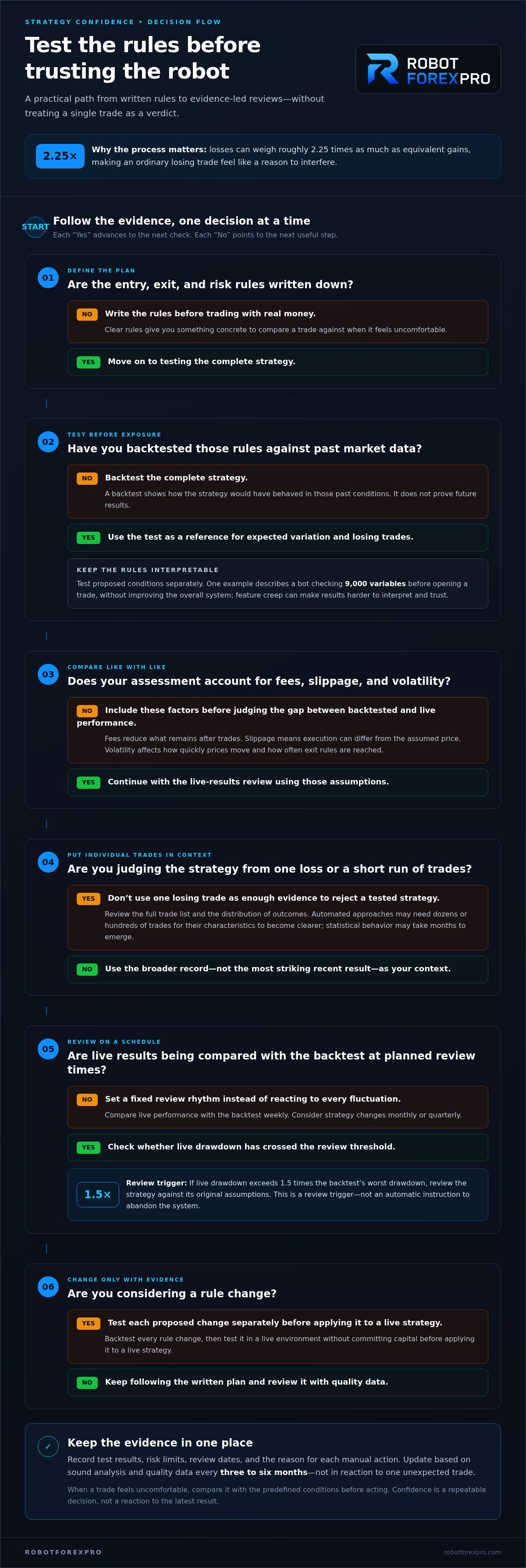
Confidence starts with testing rules before exposing real money. Define the robot’s entry, exit, and risk rules, then backtest them against past market data. A backtest shows how the strategy would have behaved in those conditions. It doesn’t prove future results, but it gives you a basis for understanding losing trades and expected variation.
Test the complete strategy, not a growing pile of extra conditions. One example describes a bot checking 9,000 variables before opening a trade, without improving the overall system. Feature creep can make results harder to interpret and the strategy harder to trust. Start with rules that have a clear purpose, then test each proposed change separately.
Include fees, slippage, and market volatility when assessing results. Fees reduce what remains after trades, while slippage means execution can differ from the assumed price. Volatility can affect how quickly prices move and how often exit rules are reached. These factors help explain the gap between backtested and live performance, so compare like with like.
One losing trade isn’t enough evidence to reject a tested strategy. Automated approaches may need dozens or hundreds of trades before their characteristics become clearer, and statistical behavior may take months to emerge. Review the full trade list and the distribution of outcomes. A striking recent loss can dominate attention, but the broader record gives better context for deciding what to do.
Use a fixed review schedule instead of monitoring every result. Compare live performance with the backtest weekly, then consider strategy changes monthly or quarterly. If live drawdown exceeds 1.5 times the backtest’s worst drawdown, review the strategy against its original assumptions. This threshold is a review trigger, not an automatic instruction to abandon the system.
Make changes only when data supports them. Backtest every rule change and test it in a live environment without committing capital before applying it to a live strategy. Update based on sound analysis and quality data every three to six months, rather than reacting to one unexpected trade. A review may confirm that the original rules still fit or identify a reason for measured adjustment.
Trusting a strategy means accepting that individual trades can lose while the system follows its rules. Keep a written record of test results, risk limits, and review dates. When a trade feels uncomfortable, compare it with those predefined conditions before taking action. This process makes confidence a repeatable decision, not a reaction to the latest result.
Fear of giving back unrealized profits
A profitable position can still create pressure to act. The displayed gain may shrink during a pullback, and closing early can feel safer than watching profits disappear. That reaction protects a temporary result, but it can also cut short a strategy designed to capture a sustained move. Separate the discomfort of seeing a gain fluctuate from evidence that the strategy’s exit conditions have changed.
Automated strategies may hold positions for days or weeks while pursuing sustained trends. During that time, a market reversal can look imminent on a short-term chart, even when the system’s exit conditions haven’t been reached. Decide in advance what counts as a genuine reason to intervene. A price pullback alone isn’t the same as a signal from the strategy.
Define exit rules before a trade opens. Record the conditions that close a position, the role of any stop, and what would justify a manual override. Then compare each urge to exit against that written plan. If no rule has been triggered and there’s no operational issue, don’t replace the tested decision process with a reaction to one price move.
Fear can also turn into greed or FOMO. A trader may close a position early, then re-enter after prices rise to try to recover the move already missed. That second decision can add exposure for emotional reasons rather than strategy conditions. Instead, log the reason for every manual action and review the entries together. The record can reveal repeated early exits or impulsive re-entries.
Examples show why a pullback doesn’t always end a profitable trend. The Russell trade example says traders who exited at its first pullback left another 400 ticks of profit on the table. That illustrates one trade, not a forecast for future positions. Use it to examine how an exit rule handles pullbacks, not as a reason to hold every position longer.
A separate example gives 454 ticks as potential profit that could be captured if a pullback triggered an earlier stop. The practical lesson is not that every stop should move closer. A tighter stop can exit a position during ordinary price movement. Compare the stop logic with the strategy’s tested behavior before changing it.
Some strategies split exits across a position, but that structure still needs clear rules. In four out of five trades, the second half might be stopped out at breakeven. Treat this as a possible trade pattern, not a promise or universal outcome. Define how each portion exits, then judge the full set of results rather than the unrealized high of a single trade.
When profits fluctuate, pause before acting. Check the written exit condition, determine whether it has been met, and note any manual decision. This simple sequence helps distinguish strategy evidence from fear of giving back gains, while keeping losses and potential profits within the same rules-based framework.
4. Reducing position size to manage trading emotions
Position size affects how strongly each price move registers. If a loss causes genuine stress or anxiety, treat that response as a sign that the position may be too large. Reduce exposure before the next trade rather than changing the robot’s exit rules during an open position. A manageable size makes it easier to let the system follow its plan.
Choose a fixed risk per trade and calculate position size from that limit and the stop distance. A wider stop generally requires a smaller position to keep planned risk consistent. Record the method in writing, then scale only according to a schedule set in advance. This ties each size decision to a defined process, not the latest win or loss.
Start automated trading with small positions. Increase size gradually as the strategy demonstrates how it behaves across trades and market conditions. If a losing trade makes you check your account every few minutes despite having set stops and targets, pause before increasing exposure. Frequent monitoring may show that the current size makes the plan difficult to tolerate.
Emotional overrides often begin as small edits: moving a stop, closing too early, or pausing the robot after a loss. Create a written intervention rule that distinguishes a system issue from discomfort with a normal price move. For example, a platform failure may require action, while an unrealized loss within the strategy’s risk parameters doesn’t automatically change its exit logic.
Emotional hedging can also disguise an override. A trader may open an opposing position to ease anxiety about an automated trade, without a tested rule for that hedge. This adds another decision and can make total exposure harder to track. Before opening a manual position, record its purpose, risk, and exit condition. If it has no defined role in the strategy, don’t use it to relieve momentary stress.
Use the same review sequence after every difficult trade. Note the position size, planned risk, actual outcome, and any urge to intervene. Then ask whether the size stayed within the written limit and whether the robot followed its rules. If the loss felt intolerable despite correct execution, reduce the next position and keep the same strategy settings. Change position size and strategy rules separately, so the effect of each decision remains clear.
Comfort doesn’t prove that a strategy is sound, and discomfort doesn’t prove that it has failed. Position sizing helps bring emotional pressure within a manageable range. Set the risk limit, follow the scaling schedule, and use recorded decisions rather than anxiety to guide the next adjustment.
Uncertainty about which trades will become runners
A trade’s potential is unclear when it opens. A small early gain may reverse, while a modest move may develop into a longer run. Traders can’t know from the opening price alone which position will become the standout. That uncertainty makes consistent criteria essential: let the strategy manage exits according to its rules instead of trying to identify winners by feel.
Small samples invite sweeping conclusions. The example in this article warns against projecting results from ten trades as though they represented 1,000. A few losses can make a strategy look broken; a single large winner can make it appear stronger than its broader record. Treat early results as observations, not proof. Keep the sample size in view whenever you evaluate performance or consider changing rules.
Look at how results are distributed, not just the final balance or biggest winner. A trade list can show whether returns depend on a few long-running positions, many smaller outcomes, or a mix of both. That pattern matters because closing every trade early may remove the very runners the strategy is designed to capture. Compare the results with the system’s stated exit criteria before deciding whether performance matches expectations.
Screen time can magnify uncertainty. Watching every price tick creates repeated opportunities to question a trade that hasn’t met its exit condition. Use a written review schedule and specific questions for each review: Did the robot follow its entry rules? Did exits match the strategy? Did a manual action change the outcome? This turns screen time into a structured audit rather than a stream of emotional decisions.
Set intervention boundaries before another trade opens. Define operational events that require action, such as a platform disconnection, separately from price movement within the strategy’s rules. If a trade merely stalls, record the observation and wait for the scheduled review. If a rule change seems necessary, document the evidence and test the change before applying it. This protects the strategy from decisions driven by one unusual outcome.
Confidence comes from knowing what the system is meant to capture and what it can’t predict. It can apply repeatable criteria, but it can’t label a new trade as a future runner with certainty. Use the recorded trade outcomes to assess whether the strategy behaves as designed, then keep position decisions aligned with its predefined rules. For a rules-based approach, explore automated trading software as a practical next step.
RobotForexPro: RFP GoldenStar EA
RobotForexPro’s RFP GoldenStar EA is an automated Forex Expert Advisor for traders seeking software that executes a strategy through programmed rules. Consider it when your testing, risk limits, and review schedule are in place and you want to reduce discretionary trade execution. An EA can automate decisions, but it doesn’t replace strategy evaluation or sensible position sizing.
Choose an automated system according to the markets and approach you intend to trade. RobotForexPro also offers RFP MultiPair EA and RFP AlphaHype EA. Compare each option with your trading plan, then apply the same discipline around testing and monitoring that you would use with any automated strategy.
Visit robotforexpro.com to explore the available Expert Advisors.
Make your next trading decision deliberate
Confidence isn’t a feeling you have to wait for. Build it through a repeatable process: write down what would justify changing your plan, separate system issues from ordinary market movement, and record each intervention. The psychology of letting a trading robot run is easier to manage when your decisions follow predefined criteria rather than the pressure of a live position.
Your next step is to match an automated Expert Advisor to the strategy and markets you intend to trade. RobotForexPro offers RFP GoldenStar EA, RFP MultiPair EA, and RFP Gold V5.7 EA. Consider how an offering fits your approach, then apply your own testing, risk limits, and review process before relying on automation.
For a practical discussion about your trading approach and available Expert Advisors, contact RobotForexPro. Build a clear process, stay consistent, and make each adjustment for a defined reason.
Frequently Asked Questions
Why do emotions affect trading so much?
Emotions can make uncertain outcomes feel personal, especially when a live position is open. A sudden price move may seem like new evidence, even when the strategy’s conditions haven’t changed. Separate market information from your emotional response by recording what changed: the price, a system alert, or only your feelings. That distinction helps you decide whether the situation calls for action or observation.
How can I stop overriding my trading algorithm?
Make manual intervention a documented exception, not an informal second strategy. Before changing a trade, write down the specific condition that justifies the override and the action you plan to take. If you can’t identify a condition beyond discomfort or impatience, leave the algorithm unchanged. Later, compare your recorded reasons with the strategy’s rules to spot recurring triggers, such as reacting to a losing streak.
How does algorithmic trading help with FOMO?
An algorithm can limit FOMO-driven trades by opening positions only when defined technical conditions are met. That discipline depends on not placing manual trades around the system just because a price move looks like an opportunity. For example, if a currency pair rises sharply but the programmed entry criteria haven’t appeared, avoid chasing it manually. Record the missed opportunity and review whether the rules behaved as intended.
How do traders overcome the urge to override or stop a trading robot?
Manage the urge to intervene by identifying what would invalidate the strategy, then distinguishing that evidence from temporary anxiety. Keep a short intervention checklist beside the trading screen: system malfunction, rule breach, or changed strategy assumptions. If none applies, don’t stop the robot solely because a trade feels uncomfortable. Record the urge and revisit it during a planned review, when one price move has less influence.
What emotions and cognitive biases affect trust in algorithmic trading systems?
Fear can make ordinary losses feel like proof of failure; greed can encourage changing rules after a winning trade. Availability bias gives recent or memorable outcomes too much weight, while sunk-cost thinking can keep a trader attached to a strategy simply because time has already been invested. Reduce these distortions by reviewing dated decisions and applying predefined criteria for continuing, changing, or retiring a strategy.
How can traders set risk limits and stop-loss rules for a trading bot?
Set a fixed risk limit for each trade and define how the stop-loss fits the strategy before enabling execution. Position size should reflect the distance to the stop, so a wider stop doesn’t silently increase planned exposure. Specify what happens if the stop is triggered, whether the system may enter another trade, and which conditions pause trading. Review these settings together, because a stop alone doesn’t define total risk.
How should traders monitor an automated trading bot without micromanaging it?
Separate operational checks from performance reviews. Operational monitoring can focus on whether the platform is connected, orders are being processed, and risk controls remain active. Performance reviews can examine entries, exits, and results against the strategy’s expectations. Use alerts for meaningful operational problems, not every profit-and-loss movement. This keeps attention on system integrity without turning each price fluctuation into a reason to intervene.
What backtesting and paper-trading evidence builds confidence in a trading algorithm?
Useful evidence includes a backtest that applies the complete entry, exit, and risk rules to historical data, while accounting for trading costs and realistic execution assumptions. Paper trading can then show how the system behaves in a live-market environment without committing capital to those trades. Compare simulated execution with the backtest, note the differences, and test every rule change before using it in a live strategy.